Location: Home >> Detail
J Psychiatry Brain Sci. 2026;11(5):e260015. https://doi.org/10.20900/jpbs.20260015

1
2
Background: Cannabis legalization has expanded surveillance systems and generated a growing body of information on cannabis markets, patterns of use, and health outcomes. However, surveillance is often interpreted as though individual indicators provide a general assessment of legalization, despite legalization pursuing multiple policy, clinical, and public health objectives. Objective: To examine how well contemporary cannabis surveillance systems measure the outcomes needed to evaluate legalization and commercialization, and to identify priorities for question-oriented surveillance. Methods: This expert narrative review uses a purposive, conceptually driven synthesis of peer-reviewed studies, systematic and narrative reviews, national surveillance reports, policy documents, and consensus reports. Canadian evidence is emphasized and supplemented by evidence from other legalized jurisdictions. Sources were selected for their relevance to major surveillance domains, measurement problems, and policy or clinical questions rather than through an exhaustive systematic search. The synthesis evaluates the fitness of commonly used indicators and data sources for specific policy, clinical, and public health questions. Results: Contemporary surveillance is strongest for monitoring legal-market development, purchasing patterns, prevalence, frequency of use, and selected acute health indicators. Population surveys, retail data, and administrative systems together provide complementary information on market participation and broad patterns of cannabis use. In contrast, pharmacological dose, cumulative exposure, psychiatric morbidity, cannabis use disorder (CUD), chronic health burden, and equity are measured less consistently. Acute outcomes such as poison-centre calls and emergency presentations provide important surveillance signals but require careful interpretation because ascertainment, healthcare utilization, and diagnostic practices influence observed trends. Measures of CUD differ across diagnostic surveys, treatment systems, and administrative databases because they represent different populations and stages of clinical recognition. Across surveillance domains, individual indicators differ in their proximity to policy change, latency, specificity, and permissible inference, and no single outcome can summarize the effects of legalization. Conclusions: Contemporary cannabis surveillance provides a strong foundation for monitoring markets, patterns of use, and selected acute outcomes but is less developed for measuring clinically meaningful exposure, chronic health consequences, and distributional effects. Surveillance should be organized by matching policy questions to appropriate indicators, target populations, data sources, time horizons, and permissible inferences rather than relying on individual measures as overall indicators of legalization. Strengthening dose measurement, validating clinical indicators, improving equity-sensitive reporting, and harmonizing core measures where appropriate would improve the interpretation of cannabis policy outcomes.
Cannabis policy has shifted internationally from prohibition toward medical access, decriminalization, legalization of non-medical use, and, in some jurisdictions, regulated commercial supply [1,2]. These reforms are often grouped under the term legalization, although their public-health implications depend on regulatory design, implementation, and market development [3]. Jurisdictions differ in retail ownership, taxation, product rules, promotion, home cultivation, minimum age, and enforcement, while legal markets vary in maturity, price, product diversity, potency, and availability [4–6]. Commercialization is therefore neither an inevitable consequence of legalization nor a uniform process, but it may influence consumption and risk through changes in access, products, prices, and promotion [7–10].
Canada offers a useful case study because non-medical cannabis was legalized nationally in 2018 within a federal framework that assigned substantial authority over distribution and retail regulation to provinces and territories [11,12]. Legalization was accompanied by expansion of cannabis-specific surveys, continued use of broader health surveys, and increasing reliance on retail, administrative, poison-centre, pharmacovigilance, and linked data [10,13–16]. These systems have generated detailed information on prevalence, frequency, product forms, purchasing sources, legal-market participation, prices, risk perceptions, arrests, and selected acute health events [17–20].
Cannabis surveillance predated legalization, but legalization expanded and reoriented its purpose. Policy evaluation now extends beyond monitoring use to questions concerning youth access, product safety, illicit-market displacement, impaired driving, criminalization, treatment need, and the distribution of benefits and harms [18]. Increased adult use, reduced possession arrests, greater legal purchasing, and increased pediatric exposures could occur simultaneously and would represent different dimensions of policy performance.
For the purposes of this review, cannabis surveillance refers to the ongoing or repeated collection, analysis, interpretation, and reporting of population-, market-, or health-system data intended to monitor cannabis exposure, behaviours, markets, consequences, or policy-relevant outcomes over time [8]. Surveillance is therefore defined here by its monitoring function rather than by a particular data architecture. Population surveys, retail-market data, poison-centre records, administrative health databases, and treatment-system data may all contribute to surveillance when they are used repeatedly to characterize trends or detect changes in relevant indicators. These sources are nevertheless heterogeneous and should not be treated as methodologically equivalent.
Surveillance should also be distinguished from related activities. Epidemiologic research primarily examines the distribution, determinants, and associations of health-related states or exposures, whereas policy evaluation assesses outcomes in relation to particular regulatory interventions and stated policy objectives.8 Routine administrative or commercial data collection does not automatically constitute surveillance, although such data can become surveillance inputs when systematically analyzed and interpreted for monitoring purposes. The same underlying dataset may therefore support surveillance, epidemiologic research, and policy evaluation, but the inferential claims supported by each use differ [13,21–24].
This expert narrative review and conceptual framework paper examines how post-legalization surveillance captures cannabis markets, patterns of use, selected acute harms, psychiatric outcomes, CUD, and distributional effects. Its primary purpose is not to estimate the overall effects of legalization, but to evaluate the fitness of major surveillance indicators and data sources for different policy, clinical, and public health questions and to provide a practical framework for their selection and interpretation. The framework is intended primarily for researchers, public health and statistical agencies, policymakers, regulators, and health-system decision-makers who design, analyze, or interpret cannabis surveillance and policy evaluations.
This article was designed as an expert narrative review and conceptual framework paper rather than a systematic or scoping review. Its purpose was not to exhaustively identify and quantitatively synthesize all studies of cannabis legalization, but to examine how major surveillance indicators and data sources function when applied to different policy, clinical, and public health questions.
A purposive literature-synthesis approach was therefore used. The review integrates peer-reviewed empirical studies, systematic and narrative reviews, national surveillance reports, policy documents, and consensus reports addressing regulation and commercialization, patterns of cannabis use, exposure measurement, market development, acute and chronic harms, psychiatric outcomes, cannabis use disorder (CUD), and equity. Particular attention was given to literature describing the measurement properties, ascertainment pathways, denominators, interpretive limitations, and policy relevance of commonly used surveillance indicators. Canadian evidence was emphasized because nationwide legalization occurred within a common federal framework while substantial provincial variation remained in retail systems, implementation, and regulation. Evidence from other legalized or commercial cannabis jurisdictions was used where it clarified general measurement or policy-evaluation issues.
Sources were selected for conceptual relevance to the surveillance questions examined, methodological importance, and representation of major data-source domains rather than through an exhaustive database search or formal study-screening process. Accordingly, this review does not make claims of comprehensive literature coverage and does not undertake formal risk-of-bias assessment. Evidence is organized conceptually rather than pooled quantitatively because jurisdictions, regulatory contexts, study designs, indicators, ascertainment mechanisms, and follow-up periods differ substantially. The central analytic question is whether a given indicator and data source are fit for the specific policy, clinical, or public health question to which they are applied.
What Contemporary Surveillance MeasuresThe usefulness of cannabis surveillance depends less on the number of available indicators than on their alignment with the question being asked. Legalization may be evaluated in relation to criminal-justice reform, regulated access, youth protection, illicit-market displacement, consumer safety, impaired driving, health outcomes, or equity [25,26]. A concise heuristic is to locate indicators along a pathway from policy and regulatory conditions to market characteristics, access, patterns and intensity of exposure, risk behaviours and proximal adverse events, clinically defined disorder and impairment, and longer-term health and social outcomes. This pathway is an organizing device rather than a proven linear model. Some outcomes respond directly to legislation: possession arrests may fall rapidly when possession is no longer criminalized [27,28]. Others depend on intervening market or behavioural changes.
Table 1 operationalizes this question-oriented approach by linking common policy and clinical questions to the constructs, indicators, populations, and data sources most capable of addressing them, while identifying the principal limitations that constrain interpretation.
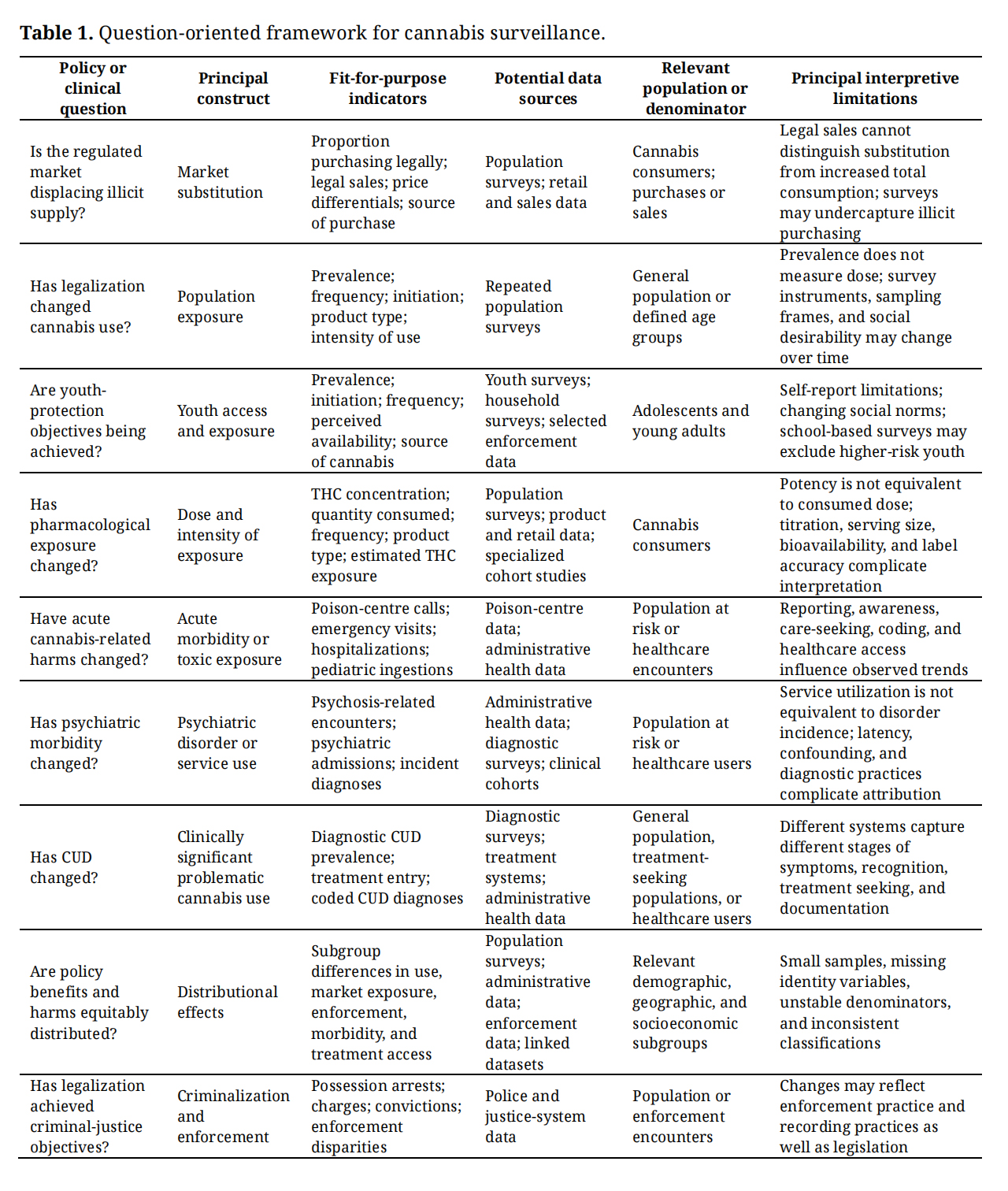 Table 1. Question-oriented framework for cannabis surveillance.
Within Canada, these surveillance functions are distributed across several complementary systems rather than housed within a single cannabis-surveillance infrastructure [12,29–31]. The Canadian Cannabis Survey (CCS), conducted annually by Health Canada, provides detailed information on cannabis use, frequency, product types, quantities consumed, sources of cannabis, purchasing behaviours, risk perceptions, and selected public-safety indicators [32]. The Canadian Community Health Survey (CCHS) provides broader population-health estimates [33–35], while the National Cannabis Survey (NCS) was developed around legalization to provide repeated estimates of cannabis use, frequency, spending, and related behaviours [17,19,36]. Other population systems, including surveys of students and substance use, provide additional information for specific populations and outcomes. Retail and regulatory systems provide complementary data on legal sales, products, prices, and market development; poison centres capture reported toxic exposures; hospital and physician administrative databases capture events reaching healthcare attention; and treatment systems characterize the subset of people entering formal care. These systems differ fundamentally in sampling frame, denominator, frequency, ascertainment, geographic coverage, and clinical depth. Their value therefore depends on the question being asked rather than on any inherent hierarchy among data sources.
Contemporary surveillance is strongest where policy change produces observable market and behavioural indicators [37,38]. In Canada, repeated surveys and market data have documented increasing legal purchasing, declining reliance on illicit sources, expansion of retail access, falling prices, and diversification of available products [39–42]. These measures are directly relevant to objectives such as displacing illicit supply and establishing a regulated market, but they should not be interpreted as evidence of health benefit on their own. Legal-market share can increase while prices fall, retail density expands, or higher-potency products become more available; each describes a different dimension of market development [43,44]. Persistence of illicit purchasing may reflect price, product selection, convenience, taxation, or established supply relationships rather than a single failure of legalization.
Surveys provide relatively consistent information on whether cannabis is used, how often it is used, the broad products consumed, and where they are obtained [45–47]. Market data add information on sales, product categories, prices, and retail growth that self-report surveys cannot capture as directly. Together, these sources describe the scale and structure of legal-market participation and broad changes in use. Their limitations become clearer when the question shifts to pharmacological intensity. Prevalence does not distinguish occasional use from sustained high-frequency exposure; frequency does not capture quantity, potency, route, or duration; and broad product categories contain substantial variation in tetrahydrocannabinol content, serving size, and bioavailability [48–50]. Potency measures concentration within a product rather than the amount consumed or absorbed, while standard THC units improve comparability without resolving uncertainty related to titration, incomplete consumption, label accuracy, or unregulated products [47,51,52].
The meaning of an indicator also depends on the population and policy objective. Greater access to regulated products among adults may indicate successful displacement of illicit supply, whereas greater access among adolescents would undermine youth-protection goals [15,53]. Household availability may facilitate lawful adult use while increasing accidental exposure among children [22,54]. Formal policy, real-world implementation, enforcement, and market maturity may also diverge, limiting simple pre–post or legal–illegal comparisons [29,55]. Market and use indicators are therefore most informative when interpreted in relation to the products, prices, access conditions, and regulatory setting in which consumption occurs.
Acute health events are prominent post-legalization signals because they may occur soon after changes in product availability, household exposure, or consumption patterns. Poison-centre calls, pediatric ingestions, emergency visits, and hospitalizations can identify changes in severe or care-seeking events and may be especially informative when a specific product or regulatory change is temporally proximate [22,54]. Pediatric edible exposures, for example, may be sensitive to product availability, packaging, and storage practices [13,22]. These data nevertheless depend on recognition, reporting, healthcare contact, and coding. Poison-centre systems capture reported events rather than all exposures, while hospital records include only events that reach clinical attention.
An increase in emergency presentations may reflect greater morbidity, but may also partly reflect heightened awareness, lower thresholds for seeking care, changes in diagnostic recognition, or altered documentation practices [56]. These explanations can coexist. Emergency and hospitalization data are therefore valuable for signal detection and service planning, but observed changes require appropriate denominators, stable definitions, and contextual information before they can be translated into population risk or attributed to policy.
The same distinction applies to psychiatric outcomes. A substantial literature links frequent or high-potency cannabis exposure with psychosis-related outcomes and other forms of psychiatric morbidity, but evidence that legalization itself changed population incidence is less certain [57]. Post-legalization studies vary in design, comparison groups, follow-up, outcome definitions, baseline trends, and regulatory settings [58]. Some identify increases in psychosis-related presentations or other psychiatric service use, whereas others report null or mixed findings. These differences may reflect true variation across populations and markets as well as limitations of available designs and data. Service-use outcomes additionally measure contact with care rather than the full prevalence or incidence of psychiatric disorder.
CUD illustrates the problem of non-equivalent ascertainment particularly clearly. Diagnostic population surveys can identify respondents who meet symptom and impairment criteria regardless of treatment seeking, but estimates depend on the diagnostic framework, instrument, screening rules, reference period, sampling frame, and nonresponse. Changes from DSM-IV to DSM-5 also affect comparability through altered criteria, thresholds, and severity classification [59,60]. Even surveys using the same diagnostic framework may differ in whether all respondents receive symptom questions, how impairment is operationalized, and which populations are excluded from household sampling [61].
Treatment systems observe a narrower group: people who recognize a problem, seek help, reach services, and receive an assessment. Administrative health data identify documented and coded disorder among those who have healthcare contact, with estimates shaped by access, clinical recognition, documentation, coding practices, care setting, and the algorithm used to define a case [62]. These systems therefore represent different points between symptoms, recognition, treatment, and documentation. Administrative records are useful for tracking service use, recurrence, comorbidity, and severe presentations, but they do not estimate all disorder in the population. Diagnostic surveys can capture untreated disorder but may underrepresent institutionalized, unstably housed, or otherwise difficult-to-sample populations. Treatment data describe demand and engagement but are also influenced by service availability, referral practices, affordability, and stigma.
Clinical outcomes therefore require separation of three questions: whether cannabis exposure is associated with an outcome, whether legalization or commercialization changed that outcome, and whether the available system measures the outcome accurately. Acute-event, psychiatric, and CUD indicators are most informative when interpreted in relation to their ascertainment pathway, severity threshold, denominator, and temporal distance from the policy or market change under study.
Cannabis surveillance draws on systems with different denominators, constructs, severity thresholds, and routes to ascertainment. Population surveys estimate self-reported behaviour within sampled populations; retail data describe legal transactions; poison centres capture reported exposures; administrative records identify healthcare encounters; and treatment systems observe those who enter care [63,64]. Each excludes events or populations by design. Household surveys may omit institutionalized or unstably housed individuals, retail data omit illicit transactions, and clinical records omit morbidity that does not result in healthcare contact [46,65,66].
Differences across these sources should not automatically be interpreted as disagreement. Stable prevalence alongside rising emergency use could indicate concentration of risk among frequent users, shifts toward higher-potency products, changes in care seeking, or changes in coding. The available data may identify the pattern without determining which explanation is correct. Similarly, rising legal sales may reflect substitution away from illicit supply, increased total consumption, or both, depending on the denominator and accompanying survey evidence.
Interpretation is further complicated by secular trends, latency, evolving markets, and concurrent policy changes [67]. Cannabis use and related outcomes may already be changing before legalization, while retail expansion, product diversification, taxation, enforcement, and public-health messaging continue to evolve afterward. Short follow-up may be adequate for arrests or pediatric exposures but insufficient for chronic psychiatric, cardiovascular, respiratory, or functional outcomes. Longer follow-up introduces additional confounding and greater divergence between the initial policy intervention and the market that ultimately develops.
Triangulation can strengthen interpretation when different systems converge or illuminate distinct stages of the same process [68]. It does not remove measurement error, selection bias, or confounding, and data linkage does not by itself establish causality. Linking survey, administrative, market, or mortality data is useful only when the underlying constructs remain interpretable and the linkage addresses a defined question.
Equity should be treated as a cross-cutting property of surveillance. Retail exposure, marketing, prices, access to legal products, enforcement, healthcare contact, treatment availability, and clinical burden may be distributed unevenly across age, income, racialized identity, geography, and mental-health status [69]. Population averages can therefore conceal concentrated harms and unequal benefits, including differences in who gains access to regulated supply, who remains exposed to criminal-justice consequences, and who reaches care when problems emerge [70]. Equity-sensitive surveillance requires subgroup reporting, valid denominators, and caution where small samples, missing identity variables, or inconsistent classifications limit inference.
The next stage of cannabis surveillance should be organized around explicit questions rather than continued accumulation of indicators. Table 1 illustrates the core question-oriented framework by linking policy and clinical questions to the constructs, populations, indicators, data sources, and interpretive limitations most relevant to their evaluation. In applying the framework, surveillance design should additionally specify the expected time horizon between policy exposure and an observable outcome and the inference that the resulting data can reasonably support. Beginning with these elements reduces the tendency to treat prevalence, emergency visits, CUD, arrests, or legal-market share as interchangeable summaries of legalization.
Responsibility for implementing this approach is necessarily distributed. Federal and provincial public health and statistical agencies are best positioned to establish and maintain harmonized core population measures; cannabis regulators and retail authorities can improve market, product, potency, price, and sales data; health ministries and health-system data custodians can strengthen administrative case definitions, linkage, and longitudinal outcome surveillance; poison centres and treatment systems provide complementary sentinel information on acute harms and treatment need; and academic researchers can evaluate validity, triangulate across systems, and distinguish surveillance signals from causal policy effects. Coordination across these actors is therefore more realistic than creation of a single centralized surveillance system.
Greater harmonization is warranted where comparable constructs are intended, particularly for frequency, product type, potency, CUD definitions, and administrative case algorithms [67,68]. Harmonization should not erase meaningful jurisdictional differences or force distinct data systems into artificial equivalence. Priority should also be given to improved measurement of dose, cumulative exposure, severity, impairment, and chronic burden, together with validation of survey measures and coded diagnoses against clinically meaningful reference standards.
Surveillance should report subgroup patterns routinely where data quality permits, including differences in market exposure, enforcement, healthcare use, treatment access, and clinical burden [30,67,71]. Selective linkage of surveys, administrative records, market data, and mortality files may improve longitudinal interpretation when it addresses a defined question and preserves the meaning of the component measures.
The objective is coordinated interpretation, not a single composite index or centralized surveillance platform. Contemporary systems already provide strong evidence on market development, broad use patterns, criminal-justice outcomes, and selected acute health signals. Their principal limitations concern pharmacological exposure, clinically defined disorder, chronic outcomes, and distributional effects. Organizing surveillance around explicit questions, constructs, populations, indicators, data sources, time horizons, and permissible inferences provides a practical framework for using existing systems more effectively while identifying where genuinely new measurement infrastructure is needed.
Not applicable. This study did not involve human participants or animals.
No data were generated or analyzed in this study.
Anees Bahji receives compensation for contract research and advisory work from the Canadian Centre of Recovery Excellence (CoRE) and serves as co-chair of the section on addiction psychiatry of the Canadian Psychiatric Association and Deputy Editor of the Canadian Journal of Addiction. He reports no pharmaceutical, cannabis-industry, or medical-device industry funding.
No specific funding was received for the preparation of this manuscript.
1.
2.
3.
4.
5.
6.
7.
8.
9.
10.
11.
12.
13.
14.
15.
16.
17.
18.
19.
20.
21.
22.
23.
24.
25.
26.
27.
28.
29.
30.
31.
32.
33.
34.
35.
36.
37.
38.
39.
40.
41.
42.
43.
44.
45.
46.
47.
48.
49.
50.
51.
52.
53.
54.
55.
56.
57.
58.
59.
60.
61.
62.
63.
64.
65.
66.
67.
68.
69.
70.
71.
Bahji A. Evaluating Cannabis Legalization Through Surveillance: A Question-Oriented Framework for Policy, Clinical, and Public Health Indicators. J Psychiatry Brain Sci. 2026;11(5):e260015. https://doi.org/10.20900/jpbs.20260015.

Copyright © Hapres Co., Ltd. Privacy Policy | Terms and Conditions


