Location: Home >> Detail
J Psychiatry Brain Sci. 2026;11(5):e260014. https://doi.org/10.20900/jpbs.20260014
 ,
Carolina Hernandorena 2 ,
Zain Pasquarella 1 ,
Dusan Kolar 1 ,
Najat Alzbeidi 3 ,
Casimiro Cabrera-Abreu 1
,
Carolina Hernandorena 2 ,
Zain Pasquarella 1 ,
Dusan Kolar 1 ,
Najat Alzbeidi 3 ,
Casimiro Cabrera-Abreu 1
1
2
3
*
Background: Interventional psychiatry procedures, including electroconvulsive therapy (ECT), intravenous ketamine, intranasal esketamine, and repetitive transcranial magnetic stimulation (rTMS), are increasingly used in patients with severe or difficult-to-treat mood disorders. However, less is known about real-world patterns of use within tertiary care services. Methods: We conducted a retrospective observational study of 1004 patients referred to a tertiary mood disorders service, of whom 894 had sufficient clinical data for analysis. Use of interventional psychiatry procedures and modality-specific patterns were examined using descriptive analyses and multivariable logistic regression models based on baseline clinical variables. Results: Overall, 302 patients (33.8%) received at least one interventional psychiatry treatment. Patients receiving these interventions more frequently presented with treatment resistance, disability, prior psychiatric hospitalization, and lifetime suicide attempts. Major depressive disorder was more common than bipolar disorder among treated patients. rTMS was the most frequently used modality (52.3%), followed by ECT (39.8%), intravenous ketamine (29.3%), and intranasal esketamine (4.3%). Across modalities, partially overlapping clinical profiles were observed, with age, comorbidity, and treatment resistance differing across groups. Conclusions: Interventional psychiatry treatments are commonly used in tertiary mood disorders services and are applied across overlapping clinical contexts shaped by illness burden. These findings describe real-world patterns of care in a specialized clinic and may inform future research on treatment sequencing and service planning.
Interventional psychiatry procedures (IVP), including electroconvulsive therapy (ECT), ketamine-based treatments, and repetitive transcranial magnetic stimulation (rTMS), are increasingly incorporated into the management of patients with severe or difficult-to-treat mood disorders [1,2]. Randomized controlled trials and meta-analyses have demonstrated the efficacy of these interventions, particularly among individuals who fail to respond adequately to conventional pharmacological and psychotherapeutic approaches [3–5]. However, much of this evidence derives from controlled research settings, and comparatively less is known about how these treatments are implemented in routine clinical practice within tertiary care services.
In real-world settings, escalation to IVP and selection among available modalities involve complex clinical decision-making processes that extend beyond diagnostic category alone [6]. Factors such as illness chronicity, functional impairment, suicidality, psychiatric comorbidity, and cumulative treatment burden are likely to shape both referral to interventional treatments and subsequent modality selection [7,8]. Furthermore, transdiagnostic factors such as alexithymia increase the clinical complexity as it correlates with PTSD, suicidality, and depressive and cyclothymic temperaments [9]. This becomes particularly relevant in tertiary mood disorders services characterized by high illness severity, diagnostic heterogeneity, and extensive prior treatment exposure.
Against this background, the present study examined real-world patterns of IVP use and modality selection in a large tertiary mood disorders cohort. Specifically, we sought to describe baseline clinical characteristics associated with receipt of any IVP and to characterize modality-specific clinical profiles associated with ECT, intravenous ketamine, and rTMS among patients receiving interventional treatments.
This retrospective observational study was conducted between March 2024 and January 2025 at a specialized Mood Disorders outpatient Service within a publicly funded tertiary care hospital affiliated with Queen’s University, serving as a regional referral center for patients with complex and difficult-to-treat mood disorders. The service provides diagnostic assessment and access to advanced somatic treatments, including ECT, intravenous ketamine, intranasal esketamine, and rTMS, following inadequate response to conventional therapies.
Clinical assessments were conducted at intake and represent a single time point for all variables included in the present analyses. Diagnostic evaluation was conducted by psychiatrists specializing in mood disorders based on DSM-5 or DSM-5-TR criteria and the primary diagnoses were categorized as major depressive disorder (MDD) or bipolar disorder (BD). Treatment-resistant depression (TRD) was restricted to documented clinical assessment of inadequate response to multiple (two or more) conventional pharmacological treatment trials and was defined independently of receipt of an interventional psychiatry procedure. The presence of TRD was treated as a marker of difficult-to-treat illness rather than a strictly operationalized regulatory definition.
The study cohort included 1004 referred patients, of whom 894 had sufficient clinical information for analysis. Data were derived from a single point in time either from routine intake or follow-up assessments, with variable-specific exclusions applied when required data were unavailable. Missing data were handled using pairwise exclusion for bivariate comparisons and listwise deletion for multivariable analyses. No imputation procedures were applied. No longitudinal data was collected regarding treatment response and sequencing.
Clinical VariablesBaseline variables included age, sex, primary diagnosis, TRD status, disability status, post-traumatic stress disorder (PTSD), history of psychiatric hospitalization, polypharmacy, and lifetime suicide attempts. Disability status was defined as receipt of benefits through the Ontario Disability Support Program (ODSP) at the time of clinical assessment. History of psychiatric hospitalization was defined as any lifetime psychiatric hospitalization occurring prior to referral to the outpatient program and was used as an indicator of illness severity. Polypharmacy was defined as the concurrent prescription of three or more psychotropic medications.
Interventional Psychiatry ExposureExposure was defined as documented receipt of ECT, intravenous ketamine, intranasal esketamine, or rTMS in the clinical record, regardless of completion of the treatment. Modalities were coded as non-mutually exclusive but sequencing of IVP modalities were not available for analysis. Separate binary indicators were created for ECT, intravenous ketamine, and rTMS. Owing to small numbers, intranasal esketamine analyses were descriptive only.
Statistical AnalysesUnivariate comparisons between patients who did and did not receive interventional psychiatry procedures were conducted using t tests and chi-square or Fisher’s exact tests, as appropriate. A multivariable logistic regression model was also conducted in the total sample (N = 894), considering IVP as the dependent variable. The model included age, sex, diagnosis, disability status, documented TRD, PTSD, history of psychiatric hospitalization, lifetime suicide attempt, and baseline polypharmacy.
Among patients treated with IVP, modality-specific (intravenous ketamine, rTMS, and ECT) patterns were examined using an exploratory multivariable logistic regression model including age, sex, diagnosis, TRD status, PTSD, psychiatric hospitalization, and lifetime suicide attempts.
Available-case analyses were used for descriptive and bivariate comparisons, while multivariable models used complete-case/listwise deletion without imputation. Because sufficiently complete information was unavailable for the 110 excluded records, they could not be systematically compared with the analytic cohort. Odds ratios with 95% confidence intervals are reported, with statistical significance set at p < 0.05. Given the observational design, regression analyses were interpreted as descriptive characterizations rather than causal or predictive models.
Baseline psychotropic medication exposure was examined descriptively and included in secondary adjusted models as a composite covariate to assess robustness of observed associations.
Univariate analysis of the 894 patients with sufficient clinical data showed that 302 (33.8%) received at least one interventional psychiatry procedure. Compared with patients who did not receive IVP, those who did showed higher rates of treatment-resistant depression (59.6% vs. 25.7%, p < 0.001), disability status (61.6% vs. 47.3%, p = 0.001), prior psychiatric hospitalization (63.9% vs. 43.4%, p < 0.001), and lifetime suicide attempts (54.6% vs. 31.6%, p < 0.001) (Table 1).
Diagnostic distribution differed between groups. Bipolar disorder was less common among IVP-treated patients than among those not receiving IVP (21.5% vs. 35.6%, p < 0.001). We also found that patients with major depressive disorder were more frequently exposed to IVP than those with bipolar disorder (38.3% vs. 23.6%; RR = 1.63, 95% CI 1.29–2.06).
Baseline age and sex distributions did not differ significantly between groups. Patients receiving IVP also showed higher rates of antipsychotic, mood-stabilizing anticonvulsant, and benzodiazepine use at intake. Antidepressant exposure was near universal across the cohort.
A multivariable logistic regression using the full analytic cohort (N = 894) was also conducted, with receipt of any IVP as the dependent variable. Documented TRD was associated with greater odds of IVP exposure (OR = 3.78, 95% CI 2.10–6.83), as was prior psychiatric hospitalization (OR = 2.56, 95% CI 1.85–3.56). Bipolar disorder was associated with lower odds of IVP exposure compared with major depressive disorder (OR = 0.43, 95% CI 0.30–0.61). Estimates for age, sex, disability, lifetime suicide attempt, PTSD, and polypharmacy were more imprecise and their confidence intervals included the null.
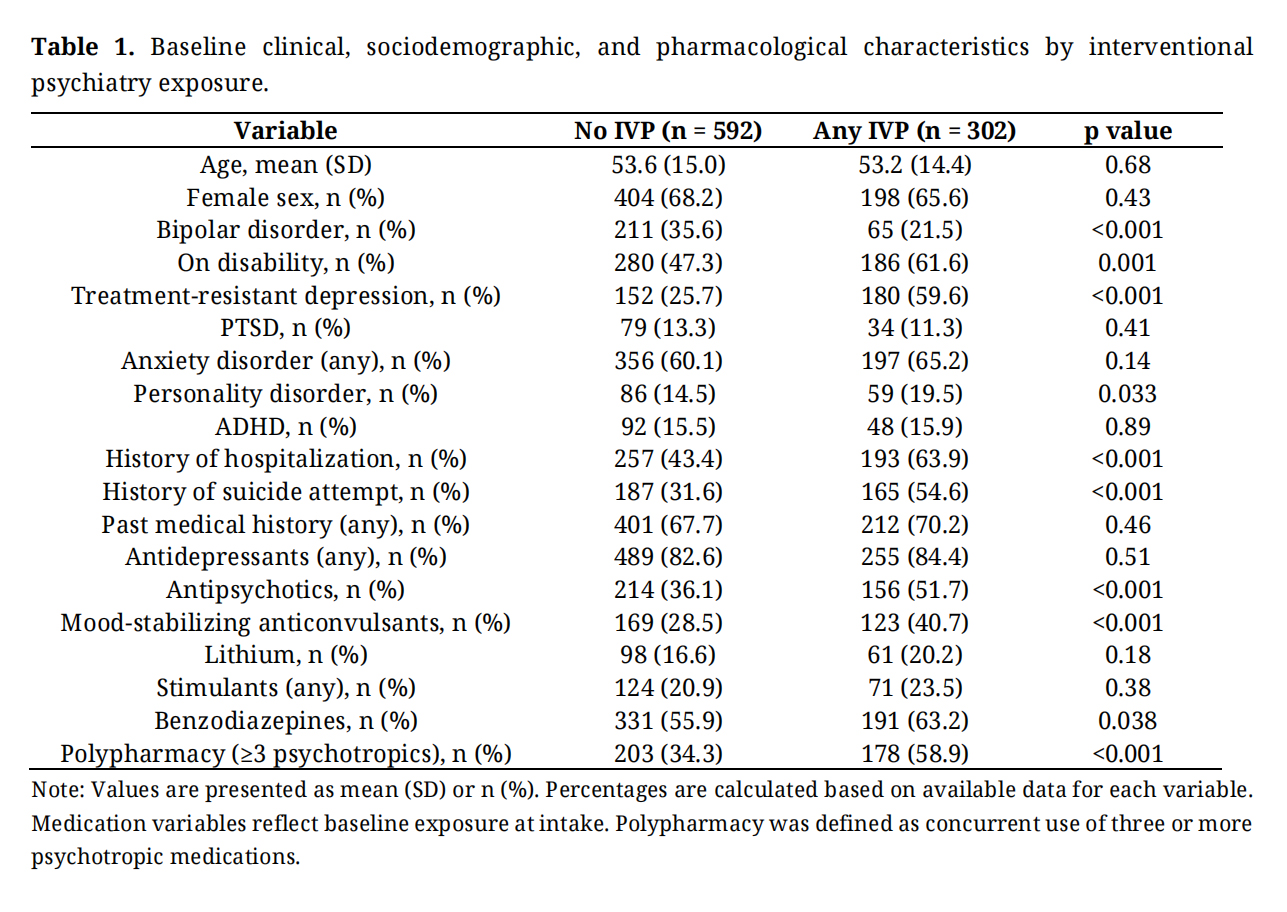 Table 1.
Baseline clinical, sociodemographic, and pharmacological characteristics by interventional psychiatry exposure.
Table 1.
Baseline clinical, sociodemographic, and pharmacological characteristics by interventional psychiatry exposure.
Among patients receiving interventional psychiatry treatments (n = 302), rTMS was the most frequently used modality (159 patients, 52.6%), followed by ECT (121 patients, 40.0%), intravenous ketamine (89 patients, 29.5%), and intranasal esketamine (13 patients, 4.3%).
Baseline medication exposure was broadly similar across modalities, with no clear medication-defined gradient distinguishing treatment groups. Interventional psychiatry modalities were not mutually exclusive, and a substantial proportion of patients received more than one intervention.
Factors Associated with ECT UseIn multivariable analyses restricted to patients receiving interventional psychiatry treatments (Table 2), ECT use was more frequently observed in older patients (OR per year = 1.03, 95% CI 1.01–1.05) and in those with a history of suicide attempts (OR = 2.71, 95% CI 1.25–5.86). Female sex was less common among ECT-treated patients (OR = 0.50, 95% CI 0.26–0.99). Comorbid PTSD was also less frequently observed in patients receiving ECT (OR = 0.34, 95% CI 0.11–0.99). Primary diagnosis, TRD status, and prior hospitalization were not significantly associated with ECT use after adjustment.
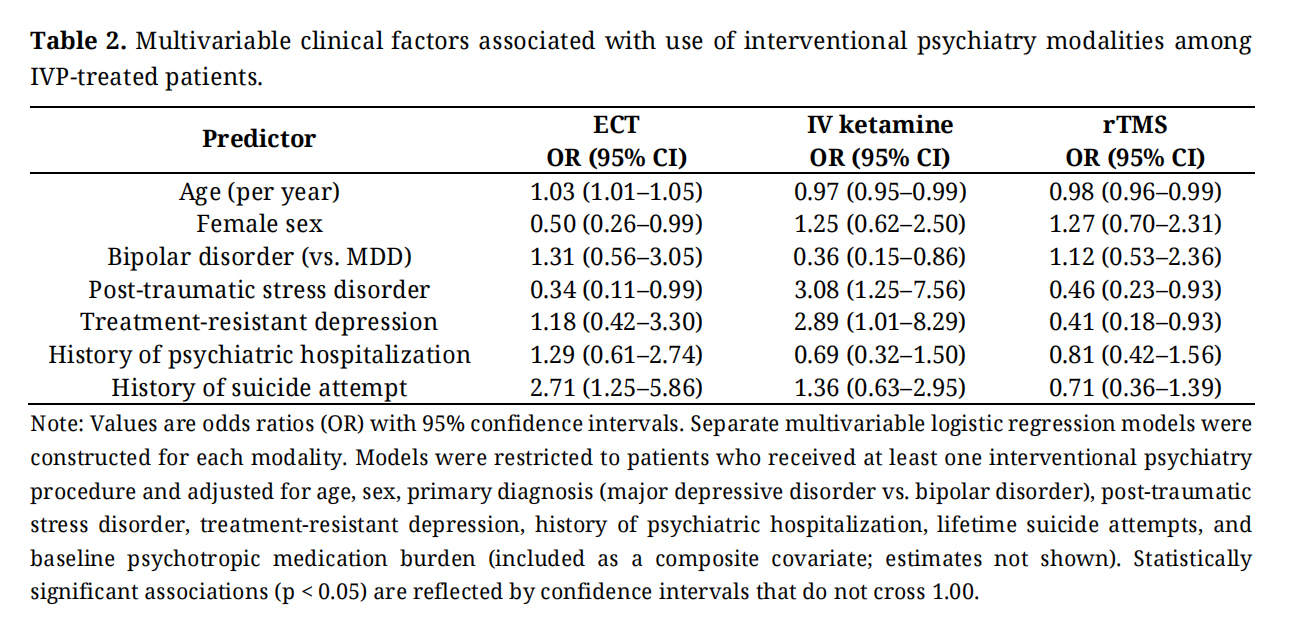 Table 2.
Multivariable clinical factors associated with use of interventional psychiatry modalities among IVP-treated patients.
Table 2.
Multivariable clinical factors associated with use of interventional psychiatry modalities among IVP-treated patients.
In multivariable analyses (Table 2), intravenous ketamine use was more frequently observed among younger patients (OR per year = 0.97, 95% CI 0.95–0.99), those with treatment-resistant depression (OR = 2.89, 95% CI 1.01–8.29), comorbid PTSD (OR = 3.08, 95% CI 1.25–7.56), and a diagnosis of major depressive disorder (OR = 0.36 for bipolar disorder vs. major depressive disorder, 95% CI 0.15–0.86). Sex, prior psychiatric hospitalization, and lifetime suicide attempts were not significantly associated with intravenous ketamine use.
Factors Associated with rTMS UseIn multivariable analyses (Table 2), rTMS use was more frequently observed among younger patients (OR per year = 0.98, 95% CI 0.96–0.99) and was less common among those with treatment-resistant depression (OR = 0.41, 95% CI 0.18–0.93) or comorbid PTSD (OR = 0.46, 95% CI 0.23–0.93). No significant associations were observed for sex, primary diagnosis, prior psychiatric hospitalization, or lifetime suicide attempts.
Intranasal EsketamineIntranasal esketamine was used in a small subset of patients (13 patients, 4.3% of those receiving interventional psychiatry treatments). Owing to limited sample size, formal multivariable analyses were not performed for this modality.
When baseline psychotropic medication exposure was included in adjusted models, primary clinical associations with ECT, intravenous ketamine, and rTMS use remained largely unchanged. No individual medication class showed a statistically significant association with modality use after adjustment.
In this large tertiary mood disorders cohort, approximately one third of patients received interventional psychiatry procedures, underscoring the central role of these treatments in specialized services. Patients receiving interventional treatments more frequently presented with treatment resistance, disability, prior hospitalization, and suicidality, likely reflecting clinical thresholds for referral and access to advanced treatments rather than independent determinants of treatment allocation [10].
At the population level, patients with major depressive disorder were more frequently exposed to interventional psychiatry treatments than those with bipolar disorder. This pattern may reflect referral pathways, perceived risk–benefit considerations, and service-level factors within publicly funded systems rather than diagnosis-driven treatment preferences. Other contextual factors such as disability, social burden, housing quality are likely to play a role in accessibility and severity of depressive symptoms [11]. Once patients received interventional treatments, diagnostic category showed more limited differentiation across modalities.
Across modalities, partially overlapping clinical profiles were observed. ECT was more frequently used among older patients and those with prior suicide attempts and was less common in patients with comorbid PTSD. Intravenous ketamine was more frequently observed among younger patients with treatment-resistant depression and comorbid PTSD and among those with major depressive disorder. rTMS was more commonly used in younger patients and was less frequent among patients with treatment resistance or PTSD. These patterns should be interpreted as descriptive characterizations of service-level practice rather than evidence of causal treatment selection mechanisms.
These results partially contrast the clinical profiles obtained in other centers for ECT users: ECT use has been consistently associated with female sex [12,13]. The lower representation of women among ECT recipients in out sample is likely to be the result of an exploratory association rather than evidence of a systematic sex-based difference in treatment selection. Other variables such as age or diagnosis (MDD vs. BD) have shown mixed results. Age appears to vary, with Asian cohorts displaying a trend to younger age for ECT users [13,14] and north American and Australian cohorts favoring older age [15,16]. Within mood disorders, ECT use has been associated both to BD and MDD with inconsistent evidence for a diagnostic trend [16,17].
Intranasal esketamine was used infrequently, likely reflecting access, funding, and regulatory constraints [18].
Baseline pharmacological complexity was common among patients receiving interventional treatments, reflecting advanced illness stage and extensive prior treatment exposure [1,2]. However, medication burden did not substantially differentiate treatment modalities after adjustment, suggesting that modality use is more closely aligned with broader clinical profiles than with medication failure alone [19]. Together, these findings describe real-world patterns of interventional psychiatry use within a publicly funded tertiary care service shaped by illness burden [9,20]. Although our results may present limitations regarding generalizability to larger community settings given the clinical complexity derived from a specialized tertiary care clinic, the display that IVP procedures constitute an important component of care for a substantial subgroup of patients, particularly those with treatment resistance and markers of greater illness burden. At the same time, the heterogeneity and clinical characteristics overlap in modality use suggest that treatment pathways are individualized rather than determined by diagnosis alone. Longitudinal studies are needed to clarify optimal treatment sequencing within stepped-care models. Future studies would benefit from further clinical characterization of depressive episodes, previous response to pharmacological treatment, as well as documenting patient preferences and accessibility.
This study was limited by its retrospective, single-site design and reliance on routinely collected clinical data, resulting in incomplete documentation for some variables and the use of complete-case analyses. Selection bias is likely to be present considering the sample is based on a specialized tertiary mood disorders service, with a population with greater clinical complexity and treatment burden than would generally be expected in community settings. Exclusion of patients with insufficient clinical information may have introduced additional bias. Treatment-resistant depression and related clinical variables reflect naturalistic referral thresholds rather than strictly operationalized constructs and may partially capture service-level decision processes. The small number of patients receiving intranasal esketamine limited modality-specific analyses. The cross-sectional nature of the data limited any longitudinal analysis, including but not limited to changes in medications, treatment sequencing, treatment response (current and previous), treatment completion/number of sessions or infusions, symptomatic improvement or worsening. There was a lack of standardized information regarding episode polarity or clinical characterization of the depressive episodes considering symptom severity, psychotic or catatonic features, and acute suicidal urgency. Data was absent or insufficient to determine reasons for IVP modality, such as patient preference or contraindication as well as potential influence of healthcare-system and treatment-availability factors. When more than one IVP modality was used in an individual, exact treatment combinations and sequencing could not be reliably reconstructed. Given the observational design, causal inferences cannot be made.
Approximately one third of patients in this tertiary service received interventional psychiatry treatments and more frequently presented with treatment resistance, functional impairment, and suicidality. Partially overlapping clinical profiles characterized use of ECT, intravenous ketamine, and rTMS, reflecting illness burden rather than diagnosis or medication failure alone. These findings describe real-world treatment patterns and highlight the need for longitudinal studies to inform optimal sequencing within stepped-care models.
This study was approved by the Research Ethics Board of Queen’s University (IRB# 604523, approved on October 16, 2024). Given its retrospective nature, the requirement for informed consent was waived.
Declaration of Helsinki STROBE Reporting GuidelineAll procedures were in accordance with institutional guidelines and the Declaration of Helsinki. The Strengthening the Reporting of Observational studies in Epidemiology (STROBE) reporting guideline was followed.
The individual-level data underlying this study are not publicly available because they contain routinely collected clinical information from patients treated within a specialized psychiatric service and are subject to patient confidentiality, institutional privacy, and research-ethics requirements. Aggregate data and analytic materials supporting the findings may be available from the corresponding author upon reasonable request, subject to institutional and research-ethics approval.
Conceptualization, GV; Methodology, GV; Validation, GV and CH; Formal Analysis, GV and CH; Investigation, NA and ZP; Resources, DK, GV, and CC-A; Data Curation, NA and ZP; Writing—Original Draft Preparation, GV, CH, DK, ZP, NA, CC-A; Writing—Review & Editing, GV and CH.
The authors declare that they have no known competing financial interests or personal relationships that could have appeared to influence the work reported in this paper.
This research did not receive any specific grant from funding agencies in the public, commercial, or not-for-profit sectors.
1.
2.
3.
4.
5.
6.
7.
8.
9.
10.
11.
12.
13.
14.
15.
16.
17.
18.
19.
20.
Vazquez G, Hernandorena C, Pasquarella Z, Kolar D, Alzbeidi N, Cabrera-Abreu C. Real-World Patterns of Interventional Psychiatry Use in a Tertiary Mood Disorders Service. J Psychiatry Brain Sci. 2026;11(5):e260014. https://doi.org/10.20900/jpbs.20260014.

Copyright © Hapres Co., Ltd. Privacy Policy | Terms and Conditions


