Location: Home >> Detail
J Sustain Res. 2026;8(3):e260068. https://doi.org/10.20900/jsr20260068
 ,
Delimiro Visbal-Cadavid 2 ,
Enrique Delahoz-Domínguez 3,*
,
Delimiro Visbal-Cadavid 2 ,
Enrique Delahoz-Domínguez 3,*
1
2
3
*
Life expectancy is a central indicator of population well-being and sustainable development, but it is often analysed using linear econometric frameworks that emphasise isolated marginal associations. This study applies Bayesian network modelling to examine conditional dependencies among gross national income per capita, governance quality, logistics performance, and life expectancy at birth across 137 countries. Using a score-based hill-climbing algorithm, bootstrap validation, mutual information, and conditional probability analysis, the study identifies stable probabilistic configurations associated with different life expectancy levels. The results indicate that income presents the strongest conditional association with life expectancy, while governance quality is associated with configurations in which economic resources are more consistently linked to higher longevity outcomes. Additional benchmark regression models and sensitivity analyses are used to assess the robustness of the observed patterns. Because the study is based on cross-sectional observational data, the results should not be interpreted as causal effects. Instead, the paper’s contribution lies in providing a complementary probabilistic framework for exploring how socioeconomic and institutional indicators jointly characterise global differences in life expectancy.
The historical analysis of human development has focused primarily on life expectancy as a multidimensional process that is a synthetic measure of population well-being. A substantial number of recent studies have identified that improvements in life expectancies are the result of advances in healthcare and the structural changes that accompany economic growth, educational attainment and the quality of institutions [1]. In a cross-national comparison, countries with higher life expectancies have exhibited differing socio-economic structures; thus, longevity is viewed as a cumulative outcome caused by a variety of interrelated determinants [2]. Bayesian modelling projections reveal future trends in life expectancy will occur in dynamic non-linear patterns where there is no guarantee of global convergence [3]. Longitudinal studies have also identified that the determinants of life expectancy have changed over time, and their impact will differ based on the demographic and structural context [4]. Complex urban environments have different health indicators that respond to specific social factors, which demonstrate that must examine life expectancy as a systemic phenomenon and not a simple demographic average [5].
The literature indicates that governance influences the outcomes related to health and development. Governance affects the link between quality of institutions and health by determining government effectiveness in improving life expectancy through performance of the health system with the economic resources available to it Azimi et al. (2023) [6]. Some recent empirical studies have found that the relationship between public health expenditures and longevity has a threshold effect based on the degree of institutional quality; that is, any increase in budget would only be sustainable if and only if specific institutional standards relating to the community are exceeded [7]. Further evidence is available from studies in developed countries, indicating that the dynamics of health expenditures are shaped by environmental factors, income per capita, and life expectancy; a finding which further supports the inter-dependence between health systems [8]. Collectively, these results suggest that without taking into account the institutional frameworks that allow for the allocation and implementation of public services, it is not possible to explicate adequately the age at which individuals die.
Bayesian models have become a more significant methodological approach when analyzing complex phenomena consisting of multiple interacting variables in an uncertain environment Conditional dependencies between variables can be represented through directed acyclic graphs known as Bayesian networks, making it possible to identify the underlying probabilistic structure of social systems or healthcare, for instance [9]. Empirical studies have demonstrated that such models can characterize structural inequalities for chronic disease by integrating socioeconomic and demographic variables based on a coherent probabilistic model [10]. Additionally, using Bayesian modeling to evaluate complex interactions of both environmental and behavioral determinants of cardiovascular risk provides greater flexibility when making conclusions than conventional parametric modeling [11]. In dynamic contexts, Bayesian networks have been used to investigate social determinants of mental health. This demonstrated their potential to model plausible causal relationships without prescribing rigid a priori directions [12]. This ability to integrate structure and probability is particularly relevant for analyzing life expectancy because of multiple, interconnected mechanisms.
In parallel, the current debate on sustainable development has emphasized the need to classify national developments using probabilistic approaches that account for structural heterogeneity. Recent models have proposed typologies based on Bayesian analyses that enable the identification of differentiated performance profiles in achieving development goals, thus overcoming the limitations of traditional aggregated indices [13]. Systematic analyses of global disease burden have shown that life expectancy trends are closely linked to the epidemiological transition and the growing influence of metabolic and environmental risks [14]. Global governance indicators also provide a robust comparative framework for analyzing how different institutional configurations relate to diverging development trajectories and population well-being [15]. This comparative perspective suggests that differences in life expectancy reflect not only economic conditions but also broader structural patterns that characterize each country within the international system.
Building on this, this study aims to probabilistically model the conditional dependencies among gross national income per capita, governance quality, and logistical performance to explain observed differences in life expectancy at birth across countries. Using a discrete Bayesian network based on a score-based structural approach, the study seeks to identify structural configurations that enable probabilistic inferences and comparative scenario analyses. This approach aims not only to estimate average correlations, but also to understand how different institutional and economic combinations shape differentiated life expectancies in the current global context.
Life expectancy is one of the most cited indicators in research for determining both social and healthcare development [16]. Over the past 100 years, life expectancy has risen globally as a result of improvements in living standards, healthcare accessibility, and public health interventions [3]. For the last several decades, life expectancy has been a widely accepted demographic statistic used for estimating individual lifespans and evaluating the overall quality of life for a population; therefore, life expectancy can also serve as a framework for comparing health outcomes of analogous populations [17]. Some researchers believe that the combined effects from economic, social, and institutional factors ultimately lead to the average lifespan of an individual; as such, they assert that life expectancy should not be viewed as a single statistical measure but instead as a combined measure [16]. Life expectancy from an analytical standpoint illustrates not just a difference in health care delivery but extreme structural inequality when comparing country by country. This means that the broad range of use of this indicator over time continues to be a basic variable for use in large comparative studies even if there exists debate about conceptual definitions within the literature [18].
As life expectancy is one of the major indicators of overall population health, it is clear that discussions regarding the measurement of life expectancy naturally shift to an exploration of the socioeconomic conditions which contribute to the growth and development of life expectancy amongst different countries. Many studies support a relationship between life expectancy and different socioeconomic conditions both in terms of income level and economic development. Additionally, there is much empirical evidence that shows a direct correlation between the level of per capita income and life expectancy, especially in low and middle-income countries, where even minor increases in income can result in major enhancements to health [19]. However, this relationship appears to diminish as countries become higher-income countries, implying that the return on additional units of income has become progressively less and that other influences are also present in determining life expectancy.
In addition to simply providing more money to people through raising salaries/wages to increase their overall wealth, experts indicate that increasing the overall economy will result in improved health status. When looking at different countries that have similar amounts of money (GDP) but experience vastly different health outcomes (ex: life expectancy), we can see that there seem to be other variables involved in determining life expectancy, such as the level of services provided by the government or private sector [20]. Therefore, life expectancy must be seen as a function of a combination of the availability of resources (money) and how they interact with the way the country is organized socially and via government policies [21,22].
Nevertheless, simply having access to financial resources alone cannot completely clarify observed differences in life expectancy between countries. The way these resources are utilized and distributed through healthcare systems needs to be examined. Public health expenditure has been the focus of extensive research because of its impact as a policy tool for improving life expectancy. Many studies link increased health care system expenditures to increased life expectancy through access to services, increased quality of services, and enhancement of preventative health measures [23]. Nevertheless, research focusing on empirical evidence shows conflicting findings, and studies that do include context show little or no effect of health expenditures on life expectancy.
This variability has led researchers to emphasize that the effectiveness of health spending fundamentally depends on the institutional environment in which the resources are allocated. Countries that have similar health expenditures will often demonstrate great variability with respect to life expectancy; thus, spending efficiency and institutional capacity play a critical role in determining whether countries have similar life expectancies despite their similar amounts of spending [24]. As comparative governance studies show, health spending alone cannot explain the variation between countries in terms of life expectancy outcomes without the consideration of public system functioning and performance [25].
Increasingly, important evidence indicates that health expenditures, when viewed as a stand-alone determinant, do not fully explain differences in life expectancy across populations; therefore, the presence of good institutional frameworks and the quality of governance emerging as key factors in the understanding of life expectancy. A number of studies suggest that the quality of governance is one of the main determinants of life expectancy. Studies that measure institutional effectiveness suggest that when governments function effectively, they are able to convert economic resources and health expenditures into health improvements [26]. The authors make the argument that governance is responsible for determining how incentives work; for determining whether there is an accountability system; and for the degree to which public health policies will be implemented, all of which affect the health of the population. Conversely, inefficient or poorly structured forms of governance are associated with low-quality public service delivery, corruption and the misallocation of funds, which limit the potential impact of health investments on population life expectancy [27,28]. Transnational studies have repeatedly demonstrated that the variation in life expectancy is strongly associated with indicators of governance, even after controlling for income and health expenditures. Furthermore, these results reinforce the hypothesis that life expectancy is heavily influenced by the institutional environment and not just an economic outcome [29].
These issues related to institutions pose serious methodological problems when examining the determinants of life expectancy across countries. Though the governance and institution variables (and their correlation to life expectancy) are increasingly acknowledged, the vast majority of empirical research uses either linear or correlation methods to investigate the life expectancy of various countries. While these methods provide useful information, they generally are predicated on linear and independent assumptions that are often inaccurate when applied to the complexities of social systems [30]. Thus, these methods can mask indirect effects and conditional relationships between socioeconomic and institutional factors.
Recent contributions to sustainability assessment have emphasized that indicators such as life expectancy should not be interpreted in isolation, but as part of broader multidimensional systems that combine economic, social, institutional, and environmental dimensions. At the macro-national level, Shmelev (2025) [31] demonstrates that sustainability performance depends on the weighting and interaction of multiple indicators across economic, social, and environmental domains. This perspective is directly relevant to the present study because life expectancy is treated not merely as a health outcome, but as a systemic development indicator conditioned by socioeconomic and institutional configurations. Similarly, Shmelev et al. (2023) [32] show that urban and regional sustainability depends on interdisciplinary linkages among economic strength, social development, environmental performance, and governance-related capacities. Although their study focuses on cities and regions, it supports the central premise of this article: sustainability outcomes emerge from interconnected structures rather than isolated variables.
Advances in statistical methodology support the use of probabilistic and Bayesian approaches to represent complex relationships among the factors that influence mortality. Bayesian networks have been suggested as effective tools to model uncertainty and interdependence among research variables in social and health research conducted on a comparative basis [33]. By allowing for inferences to be made under uncertainty and for scenario analysis, Bayesian networks provide a flexible approach for making cross-national comparisons of life expectancy [2].
This study employs a quantitative and comparative approach to analyze life expectancy as a result of the interplay between socioeconomic factors, health expenditure, and the quality of governance. Instead of viewing these determinants as isolated, independent variables, the methodology is based on the assumption that life expectancy is the product of a complex system of interdependent relationships characterized by direct, indirect, and conditional effects. Within this framework, the relationships between the variables are interpreted as conditional probabilistic dependencies rather than deterministic or purely correlational connections. This distinction is fundamental to the analytical strategy, as it allows for the identification of structural configurations without imposing restrictive functional forms.
Based on this, a methodological framework is chosen that can capture this complexity without making restrictive assumptions about linearity or independence between the variables. In particular, A Bayesian network is used as the central analytical tool because it is well-suited for modelling probabilistic structures in social systems where multiple factors interact simultaneously. Formally, the Bayesian network represents the joint probability distribution of the system as a factorisation of a directed acyclic graph (DAG), where each node is conditionally independent of its non-offspring, taking into account its parent nodes. This representation allows for consistent probabilistic inferences while maintaining structural interpretability. Consequently, because the study is cross-sectional and observational, the learned DAG is not interpreted as a causal graph. Edge direction reflects the algorithmic structure that optimises the network score under the selected assumptions, not causal identification.
It is important to emphasize that the goal of the analysis is not to establish strong causality, but rather to discover stable patterns of probabilistic dependence that characterize the heterogeneity of life expectancy between countries. In this sense, the methodological approach focuses on structural interpretation under uncertainty rather than causal estimation in the experimental sense.
Selection of Databases and VariablesThe data set used in this analysis comes from numerous sources that are standardized and widely used, such as the World Bank (World Development Indicators), the World Health Organization’s database of health spending, and the World Governance Indicators. The sample for this research project was 137 countries, based on data availability. All variables are based on the most current year for which there is full transnational coverage for all countries at the time that data was collected. For the minor differences in time between the sources, the nearest year in time was selected, and short-term structural stability of macroeconomic indicators was assumed. Therefore, the dataset should be interpreted as a cross-sectional representation of country-level socioeconomic, institutional, logistical, and health conditions. This design does not capture temporal persistence, lagged institutional effects, demographic transition processes, or feedback between health and development.
Life expectancy at birth is the main variable used in this study. Life expectancy is also a composite measure of population health. Life expectancy at birth is frequently used as part of international comparisons of data. Life expectancy at birth reflects the result of several variables over the years, including the structure of the economy, institutions, and politics.
This study’s methodology uses an analytic framework that comprehensively addresses all elements of development across its various structural dimensions and their relationships with life expectancy at birth. Therefore, the framework integrates the Logistics Performance Index (LPI) and Global Governance Indicators (GGI), Human Development Index (HDI) and geographic classifications in order to depict the various components influencing international health outcomes.
The Logistics Performance Index represents the logistics dimension by its six components: Customs Assessment (the efficiency of customs processes), Infrastructure Assessment (the quality of logistics infrastructure), International Shipping Assessment (ease of international shipping), Logistics Competence and Quality Assessment (competence and quality of logistics services), On-Time Delivery Assessment (on-time delivery), and Shipment Tracking and Traceability Assessment (tracking and tracing capabilities). These logistics performance indicators represent the operating efficiency of logistics systems in the countries, as they determine access to essential goods, services, medical supplies, and critical supply chains. Ultimately, they may also directly and indirectly affect the well-being and health of a nation’s population [34]. Institutional quality is based on the Global Governance Indicators (GGI), which include the following six dimensions: participatory and accountable governance, political stability and non-violence, effective government, regulatory quality, the rule of law, and anti-corruption. The indicators of governance look at the circumstances in which public policy is created and how governments can convert economic and logistical resources into positive social outcomes. The governance model includes both logistical effectiveness and human development as part of the overall picture of governance [35].
The inclusion of logistics and governance characteristics in this research has a theoretical basis because they act as a system that helps transform economic resources into health outcomes that are effective. Instead of viewing them as separate predictors, logistics and governance are conceptualized as having a structural interrelationship with one another in a probabilistic relationship between development and health.
The human development aspect of the HDI consists of 4 different components of measurement which are based upon life expectancy at birth (the main variable), and the average and expected years of education and per capita GNI (the four structural variables). This set of variables permits the examination of life expectancy not as an isolated variable but as the result of cumulative effects of educational, economic, and institutional factors through time [36]. Finally, a categorical variable of geographical region is included to divide all the countries in the database into 7 major regions (East Asia/Pacific; Europe and Central Asia; Latin America/Caribbean; Middle East/North Africa; North America; South Asia; and Sub-Saharan Africa), and the regional dimension captures some of the unobservable structural heterogeneities that are produced by common histories, shared patterns in their development, and similar institutional structures. The incorporation of these dimensions in a Bayesian network enables an explicit representation of probabilistic dependencies for variables such as logistics, governance, human development, and life expectancy. Using this type of modeling avoids the assumption that there are only one-way causal relationships between these factors and provides a more accurate representation of the complexity of the system that was analyzed. To ensure that all continuous indicators have the same distribution and to maximize the entropy associated with the dependent variable, empirical quantile thresholds were used to discretize them. This strategy improves the stability of the conditional probability estimation while minimizing sensitivity to extreme values. Alternative categorization schemes were investigated as robustness tests, which yielded consistent structural patterns.
The analysis is based on a single cross-sectional dataset. For each country, the most recent year with complete information across all selected indicators was used. When exact-year alignment was not possible across data sources, the closest available year was selected within a defined window of (insert years, e.g., 2021–2023) (See Table 1). Therefore, the model should be interpreted as a cross-sectional probabilistic representation of country-level differences rather than a longitudinal model of temporal change.
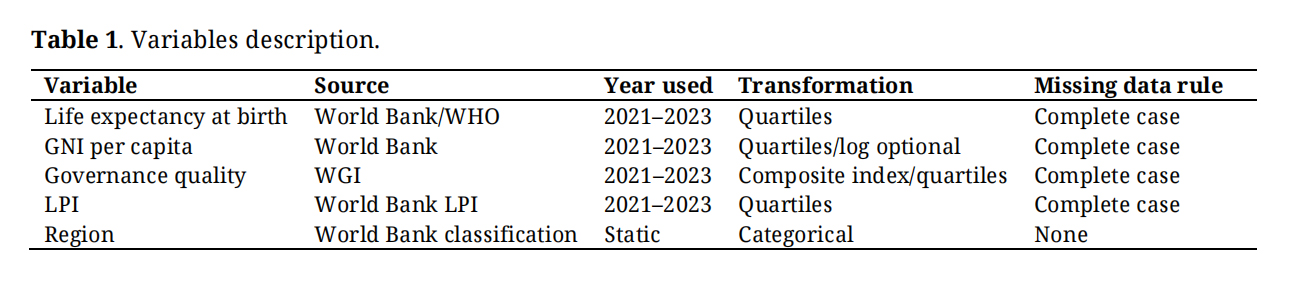 Table 1. Variables description.
The use of Bayesian networks as the main analytical method is due to the limitations of traditional econometric methods in analysing complex phenomena (like population health) where more than one cause and effect occur. Ordinary least squares (OLS) regression models allow for the identification of average relationships between two variables, and thus allow for value prediction, but they assume linear relationship by nature. As such, they assume directionality, constant marginal effect, and no conditional dependencies between the two variables, assumptions unable to be substantiated in real social systems [37].
Bayesian networks provide a way to represent relationships between variables in terms of probabilities. By being able to represent direct and indirect causal relationships, as well as those that are mediated by other variables, Bayesian networks provide an effective means to estimate the correlation between income, health spending and governance with life expectancy; particularly when the analysis seeks not just to determine the size of the correlations but also provide insight into how the combination of all three factors impact life expectancy where there is uncertainty [38].
Moreover, Bayesian networks use probabilistic inference and scenario evaluation and are therefore more comprehensive and flexible for cross-country comparative research than conventional parametric models. A Bayesian network can be created using a directed acyclic graph (DAG), which consists of nodes that represent (the selected) variables and edges that indicate probabilistic dependency relationships. Estimating continuous variables requires that they be “discrete” prior to estimation, using a statistical criterion that preserves existing variability without introducing “artificial” biases into the data set. The network structure is based on a score-based search method that identifies the “best” DAG in terms of representing the probabilistic dependencies of each data set. In this case, the “best” structure was derived from a hill-climbing (HC) algorithm within the R package bnlearn and was measured relative to the Bayesian Information Criterion (BIC). The BIC penalizes the model’s complexity by reducing an excess number of edges and, therefore, the BIC rewards more weight to parsimonious models that maintain their explanatory power. The tool used in the algorithm was completely free from predetermined target variables or any type of constraints on edges. The algorithm is designed to detect conditional dependencies directly from data. This has resulted in a pure data-driven approach where the resulting networks only contain statistically validated relationships. Therefore, the relationships in the resulting network are purely data driven, with no assumptions made as to the direction of the relationships based on theory.
This data-driven approach guarantees that the identified relationships reflect statistically validated dependency patterns while remaining conceptually interpretable within the context of development and health research. To assess the structural stability of the DAG and rule out overfitting to the sample of 137 countries, a non-parametric bootstrapping procedure with 1000 replications with replacement was implemented. In each iteration, the structural learning algorithm was executed, and the edge strength of each edge was estimated as its frequency in the learned network. Only dependencies exceeding the empirical threshold proposed by Scutari and Denis were retained. The correlations between gross national income and quality of governance with life expectancy showed frequencies of over 95%, confirming the stability of the probabilistic hierarchy despite sample variations. After defining the structure, the network parameters were estimated using maximum likelihood methods, allowing the creation of conditional probability tables for each node [39].
Maximum likelihood estimation was selected because it is asymptotically efficient under multinomial parameterization and can be applied to discrete Bayesian networks. After estimating the Bayesian network, the focus turned to determining the relationship between configurations of socioeconomic, logistical, and institutional factors and their effects on variations in the distribution of life expectancy at birth through probabilistic inference. The inference process begins by identifying evidence for certain nodes in the model; probability can then be propagated to the outcome node, and changes will occur in the conditional distribution of that node. Specifically, hypothetical scenarios will be tested by modifying the state of one or more of the key variables, such as quality of government, logistics performance, or level of economic development, while holding all other nodes in the model constant.
It allows to detect structural combinations related to high and low life expectancy, and to see how sensitive the outcome is to changes in different parts of the system as well. To test the stability of the identified relationships, repeated estimates were made using newly computed data subsets. The major structural relationships, primarily the income/governance to life expectancy links, remained consistent across runs supporting the structure’s probabilistic framework. The stability of the edges was evaluated by looking at the number of times each edge appeared across the runs with high recurrence of key dependencies supporting the structural reliability of the overall model. A comparison analysis is performed by looking at the conditional distributions of life expectancy for different countries and regions. By using a probabilistic model instead of relying solely on aggregated averages or fixed ranks, it is now possible to compare countries according to high levels of covariance in their underlying structures and see how their respective countries can be compared with one another through these shared structural characteristics, thereby providing insight into some of the similarities and differences between countries regarding the mechanisms responsible for their health status. The use of probabilistic inference helps both to interpret the model as well as to provide an analytical means of exploring the observed heterogeneity of life expectancy worldwide through a systems approach and a clearly-defined use of uncertainty. While the directed graph offers an encoding of the respective paths of conditional dependence, the probabilistic basis of the graph does not establish strict causality. Rather, it serves to summarize statistical regularities that appear in cross-national data, and thus it should not be relied upon as providing any conclusive causal identification.
In the analysis of a Bayesian network, it is evident that life expectancy at birth is determined through numerous probable construction methods as opposed to being defined by independent events. The structure estimated provides evidence of the interaction among socioeconomic, institutional and logistical factors, generating variances in the expected values of Life Expectancy levels, as depicted in Figure 1. The learned network was demonstrated to contain a number of mid-sized paths between the institutional, educational and logistical dimensions; however, subsequent analyses concentrated on two determinants that showed the most apparent direct probability relationship to Life Expectancy: Gross National Income; and Quality of Governance. The estimated structural stability of the directed acyclic graph (DAG) was established through the bootstrapping procedure specified in the methodology; life expectancy was shown to be positively related with GNI, and Quality of Governance, with both these arcs possessing recurrences of 95% or more across the 1000 bootstrap samples examined.
The life expectancy data produced through use of an Internet-based network show, respectively, that life expectancy is indirectly associated with some number of intermediate nodes and therefore establishes the systemic characteristic of the phenomenon under examination. Such data suggest that it will not be possible to adequately explain outcomes related to population health, using a one-dimensional approach.
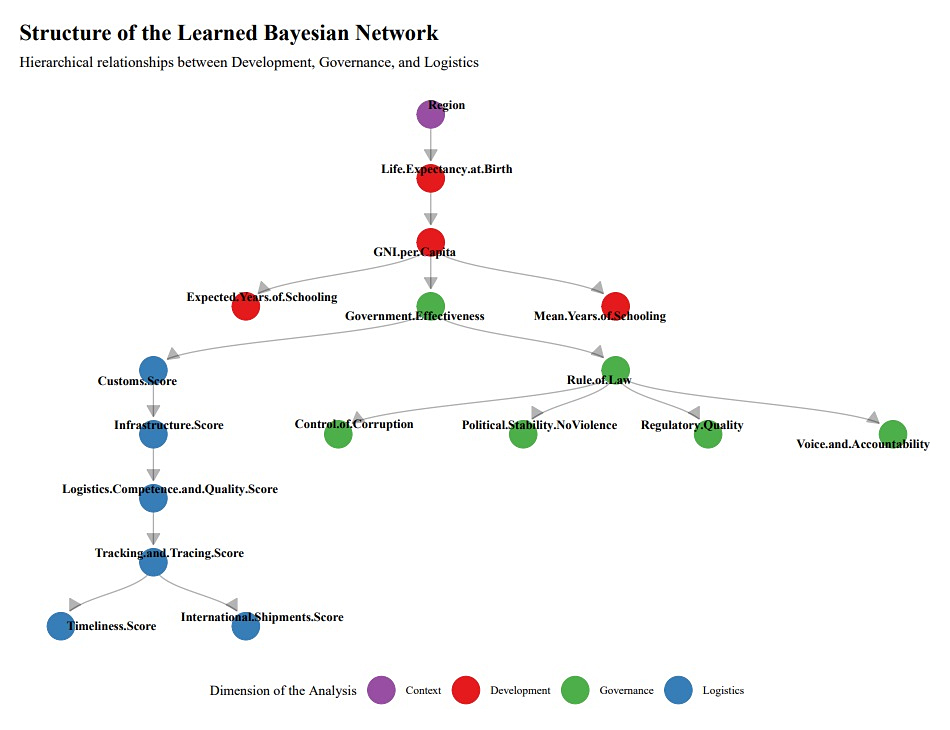 Figure 1. Estimated Bayesian network structure.
To assess the robustness of the learned Bayesian network structure, a non-parametric bootstrap procedure with 1000 replications was implemented. Table 2 reports the edge strength and direction stability for the main arcs involving gross national income, governance quality, and life expectancy. Edge strength indicates the proportion of bootstrap networks in which a given relationship was recovered, while direction stability indicates the proportion of times the arc appeared in the reported direction when the relationship was present. In addition, results are shown for both the fully data-driven network and a theory-constrained specification designed to avoid substantively implausible orientations.
 Table 2. Bootstrap-based edge strength and direction stability of selected Bayesian network arc.
The results indicate that the arcs from GNI and governance quality to life expectancy are highly stable across bootstrap replications. In the fully data-driven specification, the GNI–life expectancy relationship appears in 96% of the bootstrap networks, while the governance–life expectancy relationship appears in 93%. These values increase slightly under the theory-constrained specification, reaching 98% and 95%, respectively. Direction stability is also high for both arcs, suggesting that the reported orientations are consistently recovered across resampled datasets. The GNI–governance relationship shows moderate stability, with values of 0.78 in the data-driven model and 0.81 in the theory-constrained model, indicating that this connection is relevant but less robust than the direct associations with life expectancy.
Probabilistic Structure of Life ExpectancyThe basic probability arrangement for the dependent variable, when looking at quartiles, is determined by the marginal distribution of life expectancy at birth. Table 3 demonstrates that the distribution of life expectancy is virtually equally distributed among the four ordered categories (i.e., low, lower/middle, upper/middle, high) due to the use of a quartile method of decimalization used on the data from 137 countries. These minor asymmetries can be linked back to the original data and noted in observations. This arrangement shows there is almost no chance (high entropy) of determining life expectancy (H = 1999 bits) before conditioning there are determinants to determine. This means that there will be uncertainty in life expectancy, without any of the above-mentioned determination observations to reduce this uncertainty.
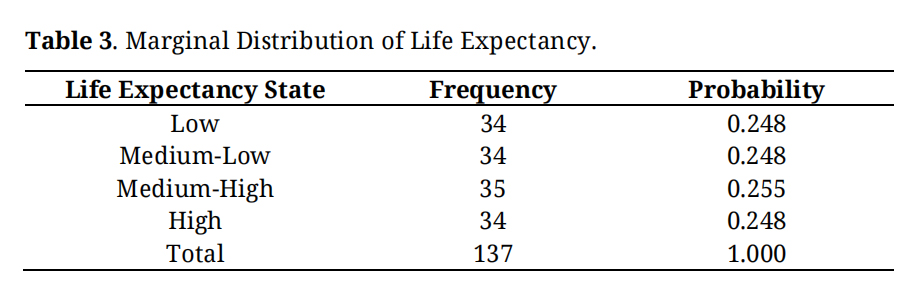 Table 3. Marginal Distribution of Life Expectancy.
The nearly uniform margin distribution means any observed reduction in entropy, via the conditional analyses, can be viewed as structurally significant vs. mechanically induced by asymmetric relationships within the dependent variable.
Before estimating the Bayesian network, the spatial distribution of life expectancy at birth was examined to provide a descriptive overview of global heterogeneity in the dependent variable. Figure 2 presents two complementary representations. Map A shows life expectancy as a continuous indicator, while Map B shows the quartile-based discretization used in the Bayesian network model. This visualization helps justify the discretization strategy by showing how countries are grouped into ordered categories of life expectancy.
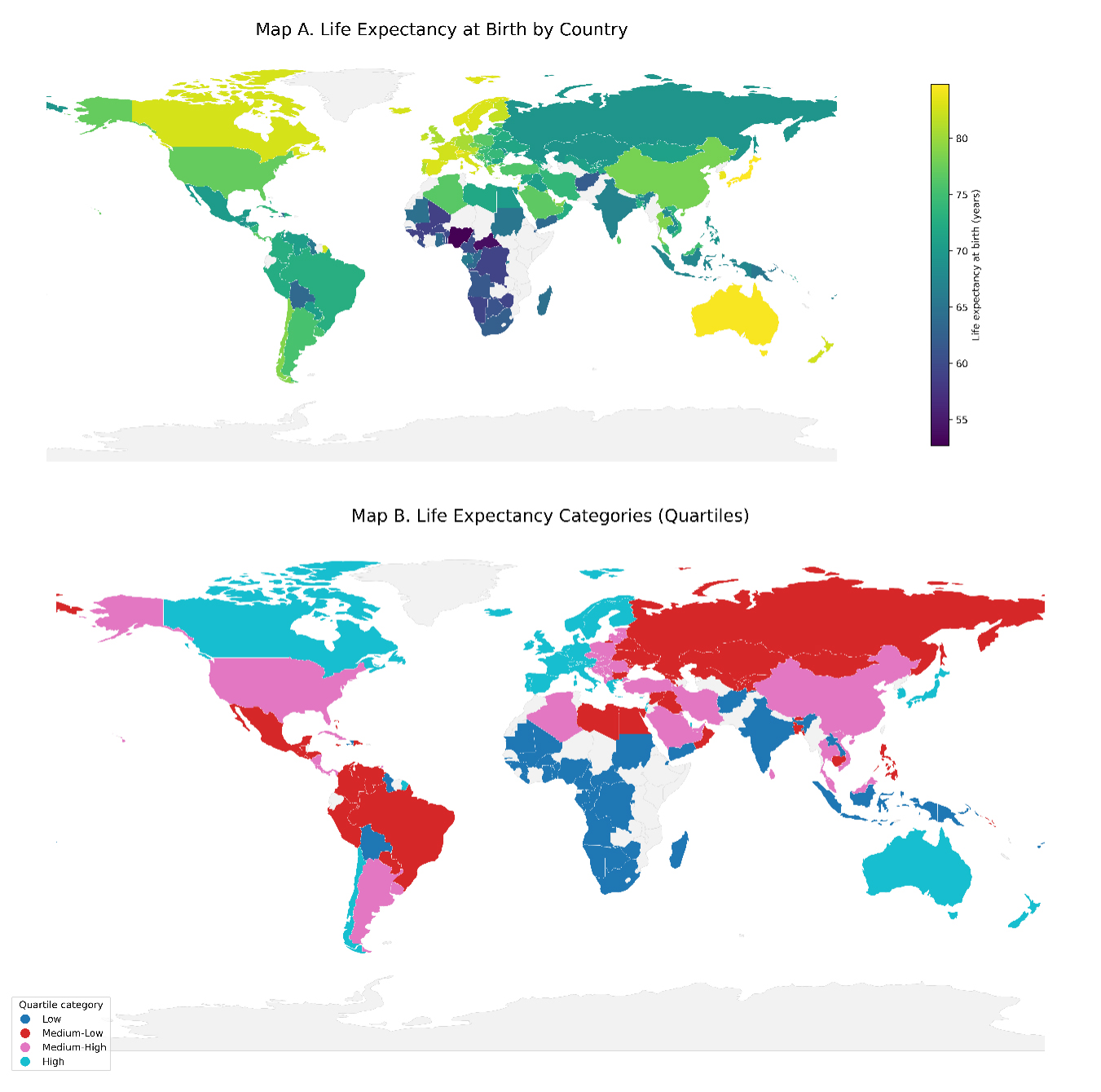 Figure 2.
Global distribution of life expectancy at birth. (Map A) it shows continuous life expectancy at birth by country. (Map B) it presents the discretized life expectancy categories used in the Bayesian network analysis, based on quartile thresholds: Q1 = 68.1, Median = 72.8, and Q3 = 78.7.
Figure 2.
Global distribution of life expectancy at birth. (Map A) it shows continuous life expectancy at birth by country. (Map B) it presents the discretized life expectancy categories used in the Bayesian network analysis, based on quartile thresholds: Q1 = 68.1, Median = 72.8, and Q3 = 78.7.
The measure of contribution (MI, CMI) of each of the economic/institutional determinants was calculated through mutual information (MI) and conditional mutual information (CMI). MI or CMI measures describe how much uncertainty, relative to a baseline entropy measure of life expectancy, has been reduced by economic and institutional determinants.
Table 4 contains grown national income (GNI) and life expectancy, showing a total MI of 0.472 bits for GNI on life expectancy. Also showing a smaller, yet still significant, MI contribution to life expectancy was governance quality at 0.338 bits.
The joint effect of the GNI and governance variable amounts to 0.612 bits of information, which is greater than either variable’s individual explanatory power. This implies that there is a structural interaction between economic ability and institutional quality. The hierarchical influence is elucidated with the use of conditional measures. Upon applying a narrowing aspect known as GNI, the resultant CMI value, when controlling for governance is moderate (CMI = 0.140 bits). Comparatively, following the control of GNI for governance, the GNI still retains a greater contribution to influence the condition (CMI = 0.274 bits). This trend indicates that the income remains as the primary structural determinant while governance remains as a mediating complement to determine that structure.
The broad scale of these effects reflects that an economic wealth-based system largely determines health outcomes through the distribution of the majority of available resources. However, the conditions created by institutional quality will either enhance or limit the extent to which economic wealth will translate into positive health outcomes.
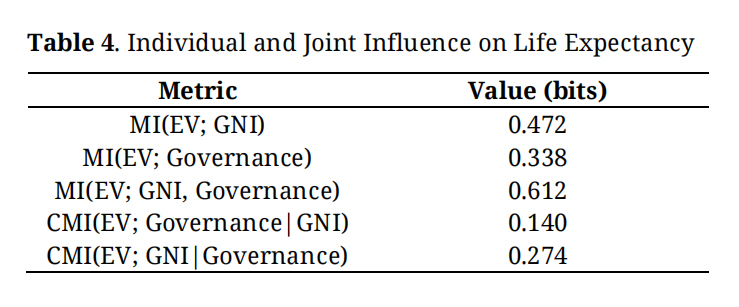 Table 4. Individual and Joint Influence on Life Expectancy.
Table 5 presents the conditional probability matrix of life expectancy given levels of governance. A clear monotonic gradient is observed. The probability of a country’s governance quartile being the lowest quartile is 48% for countries in the lowest life expectancy category (i.e., low governance quartile) and 48% for countries in the highest governance quartile and highest life expectancy category. Therefore, while governance will shift the probability (likelihood) that a country’s governance falls within a certain quartile, this statistical distribution is typical of, but not confined to, structural influences.
The gradual redistribution of probabilities demonstrates that governance should be considered a structural factor in facilitating more successful health outcomes.
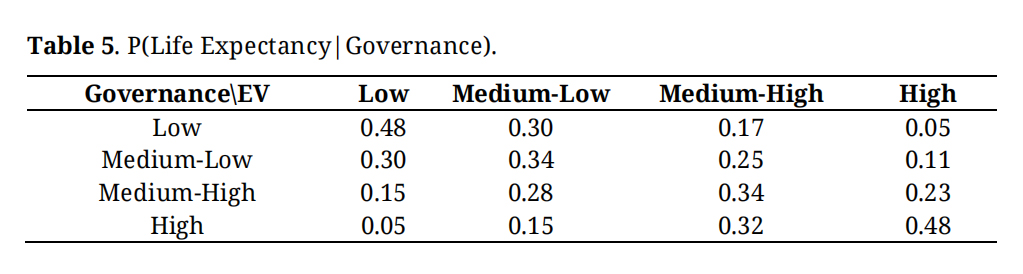 Table 5. P(Life Expectancy|Governance).
The comparative economic effect (conditional distribution P (EV/GNI)) has been more marked; referring to Table 6, the lowest income quartile has a 55% chance of falling into the lowest life expectancy category, while the highest income quartile has a 55% chance of being in the highest life expectancy category. The more pronounced redistribution of the probability mass explains the greater governance-associated impact on GNI.
The steeper economic gradient reinforces the interpretation of income as the main structural factor within the probabilistic system.
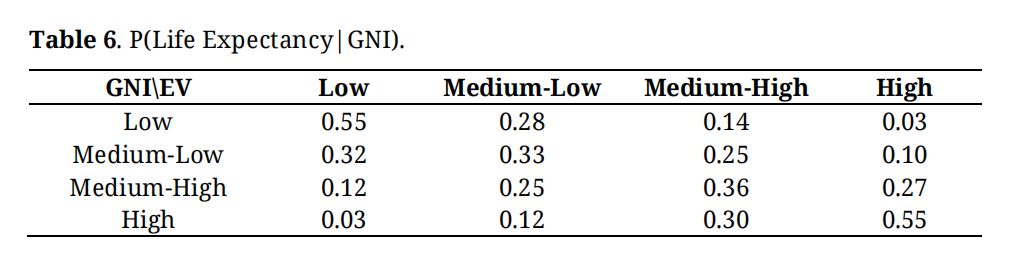 Table 6. P(Life Expectancy|GNI).
The interaction between income and governance becomes evident when examining the joint configurations (Table 7).
The combination of low income and weak governance concentrates 72% of the probability mass in the lowest life expectancy category. In contrast, the combination of high income with strong governance generates a 68% probability of achieving the highest life expectancy.
The intermediate combinations reveal that income retains substantial influence even with weak governance, but optimal outcomes are achieved when both dimensions converge favourably.
These results demonstrate that governance amplifies the returns on income in terms of health, rather than replacing it. The interaction is cumulative, but not redundant.
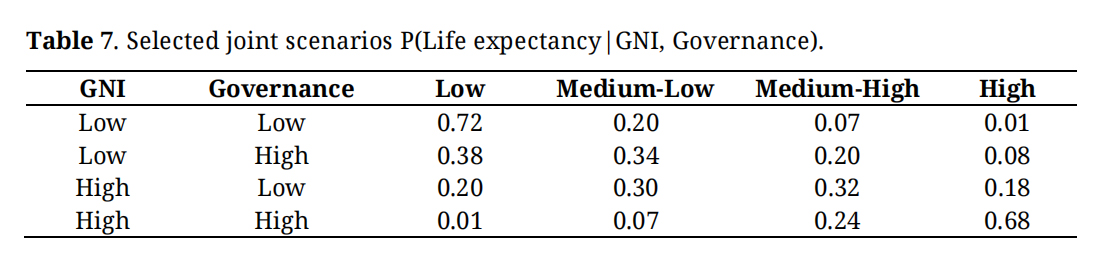 Table 7. Selected joint scenarios P(Life expectancy|GNI, Governance).
Finally, regional aggregation reveals structural geographic disparities (Table 8). Sub-Saharan Africa shows a concentration in the lower life expectancy categories, while Europe, Central Asia, and North America show a strong presence in the higher categories.
These distributions are consistent with the economic and institutional gradients identified earlier, suggesting that regional differences reflect underlying structural configurations rather than isolated anomalies.
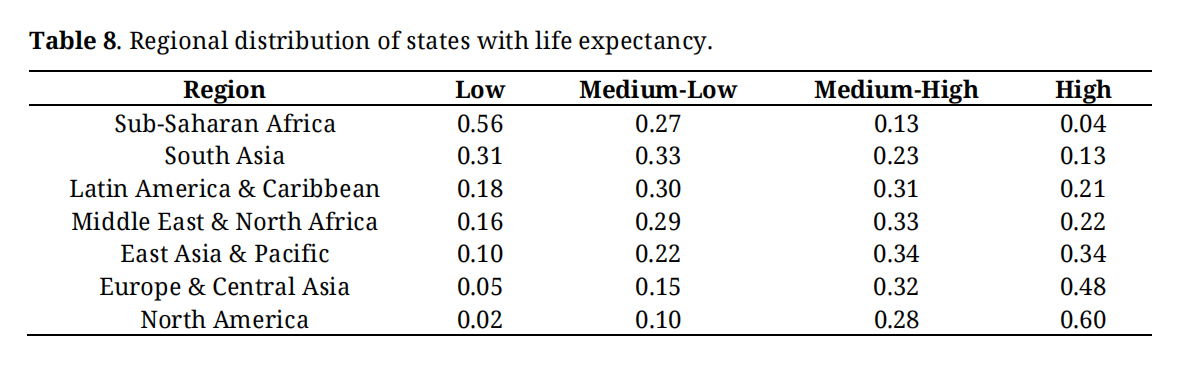 Table 8. Regional distribution of states with life expectancy.
This study supports the priori hypothesis. From an analytical standpoint, life expectancy should not be treated solely as a product of specific economic or political factors, but rather considered a probabilistic system where social, institutional, and economic factors can be modelled interactively under uncertainties. Exploring this framework of knowledge Bayesian Network method used was of much relevance model life expectancy. Unlike traditional econometric models that require the imposition of linear functional relationships between independent and dependent variables, creating a probabilistic model creates the opportunity to demonstrate how each variable (in this case, income level, quality of governance, and observed life expectancy) could be conditioned on each other in a hierarchical (i.e., stratified) framework across countries. Specifically, the mutual information values indicate that gross national income has the most influence on life expectancy. In fact, it has been noted in the literature that the interaction of both variables, at the same time, provides additional explanatory power through the relationship of governance with public health and economic growth. Additionally, it supports the conclusions drawn from more recent economic empirical studies that show that economic growth does not guarantee the continued improvement in health outcomes over time.
The conditional probability gradients suggest a complex interaction between the two dimensions (i.e., income and governance). They do not substitute for each other but rather additively contribute to their joint probability generating process. High income without strong institutions can produce relatively high probabilities of positive outcomes; however, the highest probability of being in the top quartile with respect to life expectancy only occurs when both variables are at high levels simultaneously. The implications of this pattern for national development planning are clear: Development policies should not be viewed as individual interventions. If governance is a structural mechanism that either enhances or constrains the transformation of economic resources into social outcomes, then budgeting should include institutional reform to facilitate improvements in the capacity of the state to administer its budget. In low and middle-income nations, this is especially significant.
Developing health and logistics infrastructure contributes to better living conditions, but the impact that this will have on how many years are lived depends on how much has been done to control corruption, have a stable regulatory framework and have a quality institutional environment. If there is not adequate institutional support, then the social return on public investment tends to decrease. In this regard, the Bayesian network developed in this study acts as both a simulation tool and a computing resource for testing common institutional design scenarios against a probabilistic view of how different designs would affect national level life expectancy outcomes. Additionally, this study provides empirical support for a conceptual framework that has been discussed in the literature: that institutional factors influence the degree to which economic resources are effective in translating into improvements in health for the population.
In conclusion, the identified system of probabilities also provides another interpretation of institutional quality as not just being a variable used for statistical control to measure other variables in this framework but also as an important component to this framework. In systemic terms, institutional quality is a moderating variable that modifies the impact of economic resources on systemic effectiveness by conditioning the likelihood of creating sustainable improvements in the health and well-being of a society. Neither the level of income nor the quality of governance affects life expectancy by default. While income levels are in the upper quartile of economic development or institutional strength, they still don’t guarantee that someone will live until they reach the average life expectancy. This is significant because it means that health outcomes are not just based on straight lines; they have an intricate mix of all the variables involved in determining health outcomes. The proposed methodology sees the term life expectancy as the product of the concurrent interaction of a multitude of socioeconomic and institutional factors. As such, there is considerable regional variation in the way that life expectancy is interpreted and, in the case of sub-Saharan Africa, this can be seen in the comparatively higher proportion of life expectancy observed in Europe and Northern America vis-à-vis the much lower levels that can be found in sub-Saharan Africa, which would seem to be more representative of persistent, structural configurations rather than being due simply to isolated outlying conditions. As a result, from a public policy perspective, these results provide a significant blueprint for the type of policies that can work to increase life expectancy. Rather than focusing on increases to a level of economic output or public expenditures, increasing life expectancy requires an increased focus upon the types of institutions that manage and direct the resources associated with these policies. More specifically, increasing government expenditures in marginal cases will generally only produce unequal results unless these marginal increases are accompanied by institutional reforms designed to improve the transparency, accountability, and administrative capacity of these institutions. More broadly, the study shows that Bayesian network modeling constitutes a particularly suitable analytical framework for examining the interaction between the determinants of development and health outcomes across countries. Its usefulness lies in its ability to simultaneously analyze the individual and combined contributions of different factors while maintaining the model’s interpretability and explicitly incorporating uncertainty.
The Bayesian network modelling approach presented here demonstrates that it is an analysis framework for understanding the individual and joint impacts of variable conditions on health in different countries and specifically incorporates uncertainty into its interpretation. This approach provides a shift from emphasis on estimating the individual impact of specific variables to identifying structures of determinants that together probabilistically influence the health of various nations. The contrast between the Bayesian network modelling and the analytical models used in the literature is highlighted in the approaches taken by Zhang et al. (2025) [31], who utilize gradient boosting and random forest models to identify which variables have the greatest predictive power in predicting life expectancy in countries with high rates of longevity. Their contribution centers around providing a substantial increase in predictive capability as well as ranking the importance or impact of the individual variables included in their analysis. However, the basic architecture of these models is fundamentally predictive in that they do not provide an explicit representation of the underlying conditional dependencies between the variables that influence the determinants of health. This study takes an alternative viewpoint by utilizing a Bayesian network framework to identify the key variables impacting life expectancy as well as the probabilistic relationships among the identified variables. Instead of isolating the variable importance scores, we reconstruct the underlying systemic structure from which income, governance, logistics and education influence life expectancy jointly. This structure will allow for interpretable conditional inference and counterfactual simulations and will provide a more complementary exploratory framework.to purely predictive machine learning.
In the same way, Roffia et al. (2023) [40] use fixed effect regression estimators and dynamic regressions to examine some factors that determine life expectancy in Member States of the Organization for Economic Co-operation and Development (OECD). The longitudinal econometrics methodology used in this study will take into consideration the endogeneity and time dimension of the data, but does so with predetermined functional forms, and requires the use of ex-ante directionality of cause and effect between variables. Again, in this case, relationships will be estimated as marginal effects of independent variables within a set of predetermined regression models. Conversely, this study will use score-based structural learning to directly learn the dependency structure between the variables from the data, instead of estimating average linear effects. Additionally, the Bayesian approach used in this study provides information about emergent mediators–such as governance mediating the impact of income on health outcomes–and provides a means to quantify uncertainty using the conditional probability distribution of each variable based on its relationship with other variables. As such, this study represents a shift in the methodological approach to estimating parameters using probabilistic estimation to modelling structures using probabilistic models.
In a study by Georgescu et al. (2025) [41], they used a panel ARDL approach to determine the long-term and short-term relationships between energy, migration and life expectancy in the Mediterranean region. The panel ARDL method provides the researcher with an understanding of the time series relationship, but it is subject to linear constraints and has a predetermined hierarchy of variables. Unlike the current paper which does not apply a predetermined lag specification or equilibrium structure when identifying the network structure of the 137 countries used for export estimating joint probabilities of life expectancy. This leads to a multidimensional view regarding how institutional quality, economic capability and structural governance interact together rather than separately or sequentially.
The work from Zarulli et al. (2021) [42] provided an example of how there is a methodological difference as to how to assess life expectancy. These authors employed Data Envelopment Analysis (DEA) to evaluate the relative performance of the healthcare system to produce life expectancy. Through the use of the frontier approach of gestalt analytical modelling, the analysis determines gaps in the performance of different countries in terms of life expectancy. The authors also note that the level of efficiency is measured by an aggregate life expectancy result measured against the optimal life expectancy for that country or group of countries.
On the other hand, the analysis that is being introduced herein does not evaluate efficiency using a frontier approach; rather this analysis reconstructs the probability generating process that leads to the expected life expectancy outcome. The analytical differences are significant because, instead of measuring the distance from the comfortable or ideal life expectancy for a country or group of countries to the actual life expectancy, this analysis identifies the essential combinations of governance and income that increase the likelihood of membership in the long-lived cohort. The prior body of research has established important perspectives on economics, prediction, and efficiency. However, the introduction of structural learning, probabilistic inference, and systematic interpretability into a single analytical framework separates this research from the previous literature. The unifying framework of the study represents the principal contribution of this research. In addition to identifying the most significant variables affecting life expectancy, the framework can then be used to examine how the variables exert influence via their relationships within the structure of an object (the subject); for example, structural perspective can be used to analyze all of the relationships that are involved in the emergence of life expectancy as an outcome of interdependent dynamics associated with the institutions and socioeconomic factors, thus yielding a more thorough and rigorous analytical perspective to understanding global health inequalities.
Future work should extend the model to dynamic Bayesian networks or panel Bayesian networks, in which lagged relationships among governance, income, logistics, and life expectancy can be evaluated.
Policy ImplicationThe model suggests that higher income is associated with better life expectancy outcomes, but the highest probability of belonging to the top life expectancy category occurs when high income is combined with high governance quality. Therefore, policy should avoid interpreting economic growth as automatically producing health gains. Consequently, Governance should be framed as a mechanism that conditions how effectively countries transform resources into population health. Relevant policy dimensions include corruption control, regulatory quality, rule of law, government effectiveness, and accountability.
The probabilistic patterns identified in the Bayesian network provide useful guidance for interpreting how income and governance quality interact with respect to life expectancy outcomes. Rather than suggesting a single universal policy path, the results indicate that countries may require differentiated strategies depending on their joint socioeconomic and institutional profile. Table 9 summarises four stylised country profiles derived from the interaction between income level and governance quality, together with their expected probabilistic pattern and corresponding policy priorities.
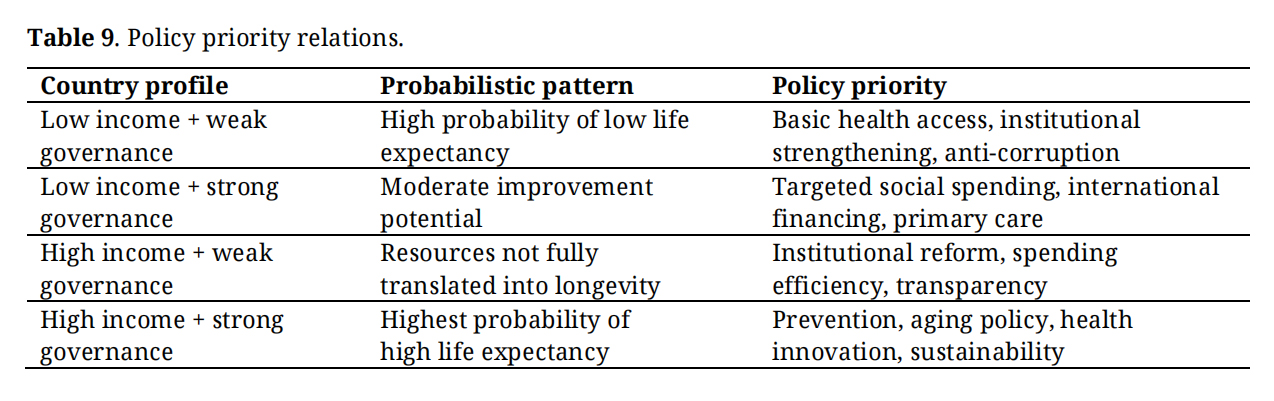 Table 9. Policy priority relations.
The objective of this study was to develop a probabilistic model for life expectancy using socioeconomic conditions and the quality of governance across multiple countries as interactive variables. The intention of the study was not to analyze each of the individual variables (e.g., income, institution quality, development indicators) separately but rather to analyze health and health outcomes as dependent on the interaction of many different factors within a population. As noted in the introduction, health at different ages is determined by a well-defined interdependent system of many different factors that exist with uncertain outcomes. To develop the Bayesian network approach, this study was able to separate the linear estimation from the structural probabilistic representation, thereby enabling the identification of the conditional dependency and joint effect of the many different variables.
The data provided a strong link between gross national income and life expectancy within the analyzed network of relationships. Governance quality was also found to play a complementary, structurally moderating role in the relationship between GNI and life expectancy. Through a mutual information analysis and conditional probability distribution analysis, the likelihood of being in the top quartile of life expectancy was greatest when economic capacity and quality of governance were positively correlated. In environments with weak governance, investments in health are likely to yield minimal returns, despite relatively abundant resources. Thus, the main argument of this manuscript is that life expectancy is not only an indicator of economic prosperity but also a function of institutional and socioeconomic configurations.
A methodological contribution of this research is that it demonstrated how structural learning algorithms and probabilistic inference could be utilized to reconstruct complex relations between development and health without being restricted by overly stringent functional assumptions. Using the Bayesian network methodology, stable dependency relationships among 137 countries were identified while maintaining interpretability and accounting for uncertainty. This provides an analytically coherent alternative to purely econometric or predictive frameworks that rely primarily on marginal effects or on ranking predictors by importance.
There are also some limitations that should be noted; for example: 1) The analysis is based on a cross-sectional approach so it does not allow for temporal interpretation or cause-and-effect over time; 2) While structural stability has been confirmed by robustness checks, the use of Discretization procedures may result in loss of information compared to continuous modeling; and 3) The Network code the probability of relationships and should not be construed as conclusive statements about causing something to happen to someone else in the ordinary usage of the term. Therefore, the findings are best understood as evidence of robust conditional associations rather than causal effects. Endogeneity, reverse causality, and omitted variable bias cannot be ruled out.
There are several future directions for research to build upon these frameworks. Longitudinal Bayesian networks, or dynamic probability structures, could be used to model how relationships between development and health evolve over time. Adding more dimensions such as sustainability, demographic transition, or health system performance measures could help to further enhance the systemic representation. Finally, doing analyses on subnetworks at the country level could help to identify heterogeneity in structural patterns that would not be available through global aggregates.
In summary, by reframing life expectancy as the outcome of an interconnected probabilistic system shaped by economic and institutional dynamics, this study promotes a more nuanced and structurally rigorous understanding of global health disparities. It invites both academics and policymakers to consider not only the amount of resources countries possess, but also how institutional configurations condition their translation into sustained improvements in population health.
The dataset of the study is available from the authors upon reasonable request.
Writing—review and editing, writing—original draft, validation, and conceptualization: AM-M, DV-C and ED-D; Methodology: AM-M and DV-C; Formal analysis: AM-M and DV-C; Software: ED-D and DV-C. All authors have read and agreed to the published version of the manuscript.
The authors declare no conflicts of interest.
This research received no external funding.
1.
2.
3.
4.
5.
6.
7.
8.
9.
10.
11.
12.
13.
14.
15.
16.
17.
18.
19.
20.
21.
22.
23.
24.
25.
26.
27.
28.
29.
30.
31.
32.
33.
34.
35.
36.
37.
38.
39.
40.
41.
42.
Mendoza-Mendoza A, Visbal-Cadavid D, Delahoz-Domínguez E. Modeling Life Expectancy Through Governance and Socioeconomic Factors: A Bayesian Network Analysis. J Sustain Res. 2026;8(3):e260068. https://doi.org/10.20900/jsr20260068.

Copyright © Hapres Co., Ltd. Privacy Policy | Terms and Conditions



