Location: Home >> Detail
Crop Breed Genet Genom. 2026;8(3):e260019. https://doi.org/10.20900/cbgg20260019
 ,
Lara Donaldson 1,3,*
,
Lara Donaldson 1,3,*
1
2
3
*
This article belongs to the Virtual Special Issue "Genetics, Genomics and NextGen Breeding for Climate Resilience"
Climate change and environmental stresses pose severe, multifaceted risks to global food security and environmental sustainability, and result in the loss of primary productivity and biodiversity that negatively impact the environmental and socio-economic conditions of affected regions. Among other approaches, priming constitutes an easy and relatively cheap strategy due to its potential to enhance germination and stress resilience under changing environments. This review examines an emerging shift in crop improvement, in which environmental stress is no longer viewed solely as a constraint but also as a potential tool for enhancing plant resilience through stress priming and molecular memory. Various priming strategies applied through methods such as hydropriming, osmopriming, hormonal priming, chemical priming, thermopriming, biopriming, and nanopriming, effectively enhance germination performance and stress tolerance through activated defense pathways, osmolyte accumulation, and antioxidant system modulation. Advances in transcriptomics, metabolomics, and proteomics have revealed key markers of the primed state, including gene expression changes, metabolite accumulation, and epigenetic programming, which can provide tools for selection. These markers offer valuable opportunities for identifying and selecting genotypes with enhanced priming responsiveness. Integrating priming technologies with modern breeding strategies, particularly genomic selection, may therefore provide a powerful framework for improving stress adaptation in crops. By combining physiological priming with advanced genomic tools, this approach offers a practical and cost-effective route to accelerate the development of climate-resilient crop varieties and support sustainable agricultural production under increasingly variable environmental conditions.
Climate change is driving long-term, significant alterations in the Earth’s climate system, most notably in temperature, precipitation, wind patterns, and the frequency of extreme weather events [1]. Climate change significantly impacts world agriculture, affecting crop yields, food production and global food security. It is a serious threat to the global agriculture [2]. For instance, temperature and changing precipitation patterns can lead to reduced crop yields. Heat stress during critical growth stages can damage crops and decrease photosynthesis, resulting in lower productivity [3]. Changes in rainfall patterns including shifts in their timing and intensity, significantly impact water availability for crops leading to reduced yields and crop failures [4]. These changes in temperature and rainfall patterns may make some areas less suitable for traditional crops, while other regions may become more favorable for different crops. This necessitates shifts in crop choices, altered planting schedules and changes in farming practices to adapt to the changing climate conditions [5].
Developing climate-resilient crops is one way to reduce the impact of climate change on agriculture. Plant breeders have long used a variety of conventional breeding techniques to develop crops with improved tolerance to both biotic (pests, diseases) and abiotic (drought, heat, salinity) stresses [6]. Selecting superior crops solely based on natural variations in phenotypic traits (observable characteristics) has several significant drawbacks, primarily due to the influence of environmental factors and limitations in capturing true genetic potential [7]. As a result, breeding crops with improved stress tolerance has been challenging. While environmental influence on phenotype has been viewed as a hurdle for accuracy, this natural variation actually represents the plant’s inherent phenotypic plasticity. Stress, whether abiotic or biotic, disrupts plant homeostasis by interfering with key metabolic and physiological processes. This disruption can lead to reduced growth, impaired development, and lower crop productivity, as well as cellular damage if the stress exceeds the plant’s tolerance limits [8]. Over longer periods, plants develop unique acclimation and adaptation mechanisms tailored to the type of stress encountered [9,10]. Plants exhibit remarkable plasticity, allowing them to adjust their growth and development in response to environmental changes. Two crucial aspects underpinning this plasticity are learning and memory, which enable plants to continually perceive environmental information and integrate past experiences into new adaptive responses. This process is essential for both immediate acclimation and long-term, even transgenerational adaptation [11]. Stress memory enables plants to “learn” from past stress, leading to faster, stronger, and more coordinated responses to recurring stress through transcriptional, epigenetic, and metabolic changes. This adaptive strategy is crucial for plant survival in fluctuating environments [12]. Rather than treating this variability as a limitation, it can be utilized as a tool to enhance productivity through stress priming. Priming is a useful approach that helps plants prepare for future stress by activating their defense mechanisms before severe stress occurs. Instead of considering environmental effects only as a problem in breeding, these effects can also be used to identify plant lines that respond well to mild or beneficial stress signals. Through priming, natural variation in plant responses can become more stable and useful for improving stress tolerance. This approach changes the breeding focus from searching only for specific stress-tolerance genes to improving the plant’s ability to respond and adapt to changing environmental conditions. Therefore, priming can help use natural variation as a valuable tool for developing climate-resilient crop varieties.
Plants that grow under natural conditions are often exposed to more than one stress factor at the same time and therefore need to adapt to different combinations of stresses [13]. Many studies have shown that the cellular responses to these environmental challenges are rather similar, which might be why plants resistant to one stress are sometimes cross-tolerant to others [14]. However, it is difficult to understand whether plants simultaneously activate different stress signaling pathways or whether a single signaling cascade controls a multitude of stress responses [15]. The physiological and molecular reactions to combined stressors differ markedly from those triggered by individual stresses [16]. Such interactions among these pathways may either intensify individual stress effects through synergistic interactions or reduce them through antagonistic interactions. Guo et al. (2021) suggested that combined stresses could characterize a “new state of environmental stresses” regulated through either positive or negative interactions of different signaling pathways, rather than just the sum of two or more stresses [17]. Among the most common and damaging combinations are drought and heat, which frequently co-occur and elicit unique responses that are not observed under either stress alone. Harmful impacts of drought and heat stress are evident on the tissue, cellular, and molecular levels. For example, stomatal closure is an immediate response to drought stress [18], while high temperatures promote stomatal opening to facilitate evaporative cooling, which helps prevent overheating [19]. The combination of drought and heat stress leads to contradictory stomatal movements, exposing plants to both severe dehydration and higher leaf temperatures [20]. Drought and heat together induce more severe alterations in physiology, biochemistry, and gene expression than each stress individually, often leading to pronounced losses in yield and quality [21].
In wheat, the effects of combined heat and drought on the physiological and yield traits were considerably stronger than those of the individual stress factors alone, but the magnitude of the effects varied for specific growth- and yield-related traits [22,23]. Chisaka et al. (2026) also confirmed synergistic interactions and factorial combinations for heat and drought stress with smaller yield losses from individual stressors and greater than expected yield losses from the combined stress [24]. In maize seedlings, Hussain et al. (2019) also found that combined drought and heat stress caused greater reductions in chlorophyll a, chlorophyll b, and total chlorophyll, as well as higher reactive oxygen species (ROS) and malondialdehyde (MDA) levels, compared to drought stress alone [25].
Previous research that has investigated the effects of combined salt and heat stress has produced inconsistent results. Some studies report synergistic effects on crop productivity, where the co-occurrence of salt and heat stress in rice results in greater yield losses than either stress alone [26]; the detrimental effects of salt stress were amplified when combined with heat, leading to more pronounced physiological damage than either stress alone in Jatropha curcas [27]. Other studies report that the combined stress inhibited shoot growth and compromised physiological parameters (e.g., relative water content, MDA, electrolyte leakage, Na+ content and Na+/K+ ratio) to a greater extent than a single salt or heat stress, demonstrating additive effects particularly on plant water status and membrane stability in wheat [28]. Interestingly, and in contrast to the expected negative effect of the stress combination on plant growth, the combination of heat and salinity provides a significant level of protection to tomato plants from the effects of salinity through the accumulation of glycine betaine and trehalose. The accumulation of these compounds under the stress combination was linked to the maintenance of high K+ concentrations and thus a lower Na+/K+ ratio, with better overall performance in terms of cell water status and photosynthesis as compared with salinity alone [29].
Thus, the interactive effects of combined stresses are not always negative. For instance, salt stress has been reported to enhance plant growth and resistance to Phoma medicaginis infection [30]. Sunarti et al. (2022) also showed that drought stress reduced disease symptoms in the susceptible tomato cultivar (MM) infected with powdery mildew [13], and drought pretreatment primed plants to become more cold tolerant [17].
Over the past decades, there has been increasing evidence that plants can be sensitized for more rapid or more intense mobilization of defense responses leading to enhanced resistance to biotic and abiotic stresses [31]. The term priming was first used to describe an enhanced immunity against pathogen attack; however, it is applied increasingly in the context of abiotic stress conditions [13]. Priming, defined as pre-exposure of plants to an eliciting factor, could trigger crop “stress memory” enabling plants be better prepared for subsequent stress exposure [14]. The priming process involves the registration and maintenance of stress records in different forms [12]. These modifications and reprogramming refer to the molecular and metabolic adjustments during and after stress priming to optimize the responses to future stress. Reprogramming enhances traits like germination and increases enzyme activity and membrane stability, thereby contributing to stress tolerance [32]. It includes shifts in gene expression, chromatin structure, and metabolic pathways and thus facilitates the transcription of genes for more effective responses to subsequent stresses. Upon stress perception, transcriptional reprogramming serves as the initial line of defense, driving rapid and dynamic alterations in gene expression, enabling plants to initiate defense and repair mechanisms. It involves the activation of specific genes in response to stress, often through transcriptional cascades triggered by environmental cues [33,34]. Concurrently, metabolic reprogramming reallocates cellular resources, sustaining physiological homeostasis through osmolyte accumulation and energy balancing while actively feeding back into epigenetic signaling cascades that do not alter the DNA sequence but affect gene expression. Superimposed on these dynamic responses, epigenetic reprogramming-driven by DNA methylation, histone modifications, and small RNA activity-establishes durable molecular stress memory. Together, these interconnected regulatory tiers systematically enhance plant resilience, with epigenetically encoded chromatin modifications creating a form of “stress memory,” allowing plants to respond more effectively to recurring stresses [34,35].
In recent years, novel approaches such as seed priming (Figure 1) have shown promising results in mitigating the adverse effects of harsh environmental conditions caused by climate change on plants [36,37]. Seed priming is a pre-sowing treatment involving the controlled hydration of seeds with various physical, chemical, or biological agents. This process initiates metabolic activities necessary for germination without allowing the radicle to emerge, placing seeds in a “primed state” that enhances their subsequent growth and resilience to stressors [38]. At the morphological level, Ru et al. (2022) [39] reported that priming improved root growth and morphology by stimulating root water uptake and thereby increasing aboveground growth of maize seedlings under heat and drought stress . At the physiological level, priming triggers metabolism prior to germination, and involves the activation of enzymes, the accumulation of metabolites, and other processes, that help shorten the lag time during germination and improve water uptake [40]. At the molecular level, seed priming enhances energetic metabolic pathways, upregulates the activity of enzymatic antioxidant systems, and stimulates the biosynthesis of osmoprotective compounds, including proline and soluble carbohydrates. These coordinated biochemical adjustments contribute to the preservation of cellular homeostasis under conditions of environmental stress [38]. Although the effects of priming vary depending on the method used, partial hydration mainly helps seeds restart important metabolic activities, including respiration and protein synthesis. It also supports cellular repair, promotes the accumulation of germination-related transcripts and enzymes, and prepares cells for division after germination begins [41].
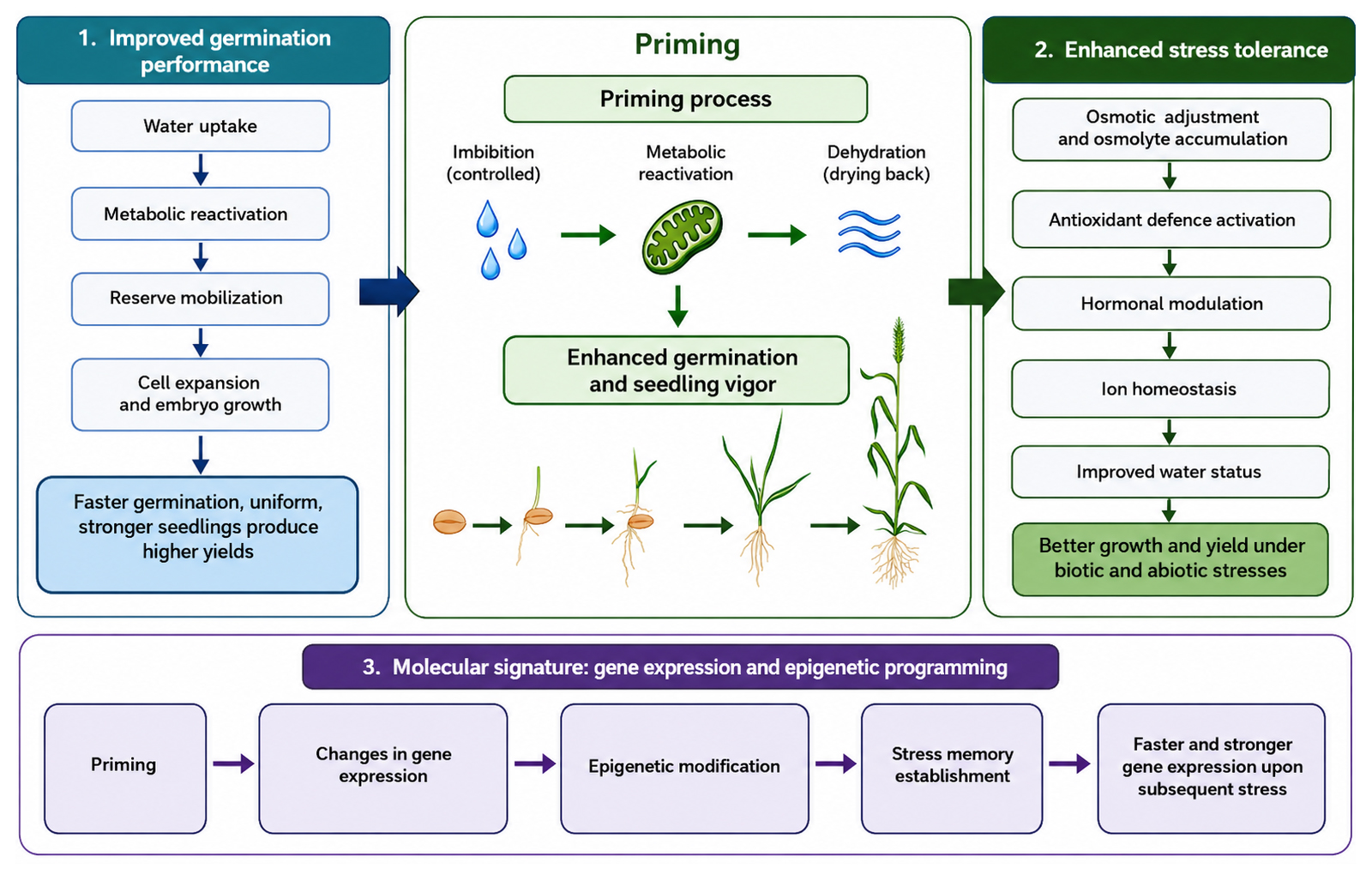 Figure 1.
Priming enhances germination performance, stress tolerance, and molecular stress memory in a representative monocot (Triticum aestivum L.).
Figure 1.
Priming enhances germination performance, stress tolerance, and molecular stress memory in a representative monocot (Triticum aestivum L.).
In addition, priming can be applied at any developmental stage to make plants more tolerant to subsequent stress events [42]. Priming of organismic responses to stress describes the phenomenon where a limited stress cue (“priming stress” cue) provokes a lasting response that is actively maintained even after the priming stress cue has subsided. Importantly, priming involves the modification of the response to a second stress cue that is separated from the priming stress cue by a stress-free interval [13,14]. Pre-exposing plants to a mild or moderate stress can enhance tolerance of plants to a later occurring stress with “stress memory” serving as the foundation of this phenomenon [43]. The term “memory” implies not only the repeated observation of a response but a modified magnitude or speed of the response, indicating a primed physiological state [44]. The stress memory response consists of three core phases: induction, maintenance, and recall [45]. During induction, sub-lethal stress or priming agents trigger signaling pathways that lead to transcriptional and metabolic adjustments. Subsequently, during maintenance, transient changes are stabilized through chromatin modifications, accumulation of protective metabolites, and enhanced antioxidant capacity. Finally, during recall, upon recurrent stress, previously “tagged” genes and pathways reactivate faster and more strongly than in non-primed plants. The existence of this memory allows plants to respond more rapidly and effectively to subsequent stress events, thereby enhancing survival and performance under challenging environmental conditions [32].
Priming can also be categorized, based on the nature of the stress signals, into cis- and trans-priming. When the eliciting cue and the later stressor are of the same nature it is termed “cis-priming.” If the initial stimulus differs fundamentally from the subsequent stress in nature, in duration or in strength, it is termed “trans-priming” [46].
Critical stages in crop production include uniform seed germination, early seedling growth, and the establishment of a uniform plant stand [47]. Considering that low crop yields are often attributed to uneven germination and poor seedling growth, priming represents an effective approach for the marked improvement of seed quality. In addition to field management techniques, priming serves as an essential method to ensure better seed germination and overall crop performance [48]. The enhancement of pre-germinative metabolic processes, including enzyme activation, cellular repair, and potentiation of antioxidant defense systems, contributes to accelerated germination, improved seedling growth, and increased crop yield. This primed state facilitates germination through the promotion of water uptake, starch hydrolysis, cell wall loosening, endosperm weakening, rapid embryonic growth, and coordinated root-shoot development [49]. In intensive agricultural systems, even marginal improvements in emergence uniformity, seedling vigor, and final yield can hold considerable agronomic significance [50]. Priming decreases seedling emergence time and increases vigor. It represents a valuable technique for modulating seed quality via the activation of specific germinative metabolic pathways, which encompass osmotic adjustment and membrane reorganization. Salleh et al. (2020) reported that improved germination performance of primed seeds was accompanied by enhanced α-amylase activity and total sugar content [51]. This increase in α-amylase activity accelerates the process of starch hydrolysis into soluble sugar which can later be absorbed by the embryo to support growth and radicle protrusion. In primed rice seeds, an accumulation of proline leads to higher germination rates and improved seedling growth compared to non-primed seeds [52]. However, the positive effect of proline was restricted to the post-emergence phase, as proline did not stimulate the germination process, but improved the initial seedling growth.
Seed priming not only boosts germination but also equips plants with enhanced metabolic, physiological, and biochemical tools to tolerate stress across multiple developmental stages, making it a versatile and sustainable strategy for crop improvement [53]. Seed priming provides protective effects against environmental stress through two main windows: immediate protection during early establishment and extended systemic tolerance during later developmental stages. Seed priming initiates metabolic processes before sowing, leading to faster and more uniform germination, improved seedling vigor, and better establishment even under stress conditions such as drought, salinity, and temperature extremes [54]. For instance, chemopriming with auxins, gibberellins, or osmolytes restores early cellular energy status under severe stress. In maize subjected to salinity stress during germination, chemopriming with indole-3-acetic acid (IAA) enhances α-amylase activity, mobilizing starch reserves to fuel coleoptile and root elongation under high salt conditions [55]. This IAA priming also upregulates tissue-specific antioxidant enzyme activities, reducing lipid peroxidation under salinity stress. Similarly, in rice germinated under submergence stress, chemopriming with gibberellic acid (GA3) or hydropriming maintained seedling energy status by optimizing oxygen consumption and balancing anaerobic fermentation pathways [56]. The benefits of priming extend beyond germination, resulting in improved growth, stress tolerance, and yield throughout the plant’s lifecycle [57]. This extended protection is largely mediated by sustained osmolyte accumulation, improved stomatal regulation, and increased antioxidant capacity. For example, chemopriming with salicylic acid (SA) in Phaseolus vulgaris and Mentha arvensis enhances subsequent salt and cadmium (Cd) tolerance by regulating stomatal conductance, increasing trichome density, and maintaining a high K⁺/Na⁺ ratio [37,58]. Furthermore, this physiological memory can persist into reproductive development; osmopriming with polyethylene glycol (PEG 6000) in tomato plants markedly improved growth parameters under salt stress while preserving fruit yield and quality attributes, including ascorbic acid and sugar levels [59].
Priming in plants often involves molecular signatures, including transcriptional reprogramming and epigenetic modifications that enhance future stress responses [60]. These changes can be somatic, intergenerational, or transgenerational, affecting gene expression from early development to maturity [61]. Epigenetic signals such as DNA methylation, histone modifications, and noncoding RNAs initiate and reinforce metastable transcriptional states, enabling cells to encode responses to environmental or developmental cues [62]. Incorporation of histone variants and post-translational modifications (such as acetylation and methylation) alter chromatin structure, making specific genes more or less accessible for transcription, which is crucial for initiating memory formation [63]. Epigenetic modifications allow plants to dynamically adjust gene expression in response to environmental changes and developmental signals, creating metastable transcriptional states that can be stable yet reversible. For example, methylation remodeling induced by drought versus salt stress exhibited significant differences in target gene selection, physiological pathway regulation, and hormonal network interaction, reflecting the precision and plasticity of plant environmental adaptation [64]. It has been reported that priming agents such as β‑aminobutyric acid (BABA) induce genome‑wide changes in cytosine methylation, with CHH hypomethylation enriched in gene promoters and transposons linked to stress responses [60]. Salt‑stress priming in soybean induced global DNA hypomethylation and altered histone modifications, fine‑tuning chromatin status to potentiate ABA‑dependent transcriptional responses, thereby enhancing tolerance to subsequent stress [65]. Thermo‑priming in Posidonia oceanica seedlings enhanced resilience to heat stress by maintaining photo‑physiological stability and epigenetic‑related gene expression, offering a promising solution for conservation and restoration under climate change [66].
Importantly, Arıkan et al. (2026) demonstrated that salt priming in Arabidopsis establishes epigenetic stress memory by altering H3K4me3 and H3K27me3 histone marks at key oxylipin and jasmonate biosynthesis genes (OPR3, AOC1, and LOX3), thereby reprogramming transcriptional dynamics to enhance tolerance during subsequent salt stress [67]. Additionally, their findings indicated that this stress application generated a priming effect, resulting in sustained alterations in gene expression, including the modulation of 12-Oxophytodienoate Reductase 3 (OPR3) and Allene Oxide Cyclase 1 (aoc1), consistent with the establishment of stress-induced memory. Following stress exposure, the expression of both genes declined and reverted to levels observed after priming. Furthermore, the deposition patterns of H3K27me3 and H3K4me3 histone marks within the OPR3 and AOC1 loci were examined to elucidate their relationship with priming and stress responsiveness. A reduction in the repressive H3K27me3 mark was observed in the promoter region of OPR3, a change that may have contributed to the transcriptional upregulation of this gene since DNA methylation at gene promoters can stably repress or activate gene expression, contributing to the initial encoding of memory.
Regarding the LOX3 gene, priming induced a persistent decrease in the repressive H3K27me3 mark at the promoter region that was maintained throughout recovery and subsequent stress exposure, whereas H3K27me3 was enriched within the gene body following stress. Conversely, levels of the activating H3K4me3 mark decreased at both the LOX3 promoter and gene body after priming and during recovery, returning to baseline levels only after stress application. This coordinated epigenetic pattern indicates a fine-tuned chromatin state during priming. The accompanying progressive decline in LOX3 gene expression after stress further implies that pre-existing transcription factor pools were sufficient to sustain the response, obviating the need for continued transcriptional activation [67]. Consistent with these findings, Pazzaglia et al. (2022) reported that the acquisition of thermopriming status in P. oceanica seedlings correlated with the expression of key genes involved in stress responses, photosynthesis, and epigenetic modifications. The overexpression of key genes involved in histone modifications suggested that primed seedlings have the potential to store priming stress information for long-lasting memorization of the past stress event [66]. Integrative analyses revealed that priming induced substantial modifications in histone H3 lysine 4 dimethylation (H3K4me2), (H3K4me3), and histone H3 lysine 9 acetylation (H3K9ac), which coordinately regulated stress responses, ion homeostasis, and cell wall remodeling.
In soybean (Glycine max) exposed to salinity, priming-induced alterations in histone marks (H3K4me2, H3K4me3, and H3K9ac) directly modulate downstream transcriptional responses by reshaping chromatin accessibility at key promoter regions [68]. Integrative epigenomic and transcriptomic profiling demonstrated that priming establishes permissive histone modifications at promoter regions enriched for stress-responsive cis-regulatory elements (including ABRE, DRE, and W-box motifs). During the recovery period, these chromatin modifications act as molecular bookmarks, keeping target loci accessible without requiring continuous transcriptional activation. Consequently, upon subsequent salt stress exposure, these pre-conditioned promoter motifs facilitate rapid transcription factor recruitment, coordinating the strategic upregulation of ion homeostasis and cell wall remodeling genes alongside the repression of unhelpful defense pathways [68].
P. polymyxa CR1, a selective Gram-positive bacterium, enhances and primes drought tolerance while simultaneously promoting plant growth and development through the reorganization of genetic and epigenetic networks [69]. Thus, priming-induced gene expression and hormone signaling creates a memory-like preparedness that allows plants to mount effective responses to distinct environmental challenges. At the molecular level, this cross-tolerance is driven by shared signaling pathways; for instance, genes in the c-repeat/Dehydration-Responsive Element Binding factor 1 (CBF/DREB1) family, traditionally characterized in cold acclimation, are also strongly upregulated by drought stress across various plant species. In response to dehydration, abscisic acid (ABA) directly regulates CBF4 expression, demonstrating how hormone signaling mediates cross-talk between distinct stress pathways. Beyond transcriptomic overlap, this shared signaling translates into functional cross-protection in crop plants. For example, early-stage drought priming (applied at the 4th and 6th leaf stages) in wheat (Triticum aestivum) significantly alleviates damage from subsequent salinity stress applied at the jointing stage. Rather than hyper-accumulating ABA, drought-primed wheat plants attenuate leaf ABA concentration during later salinity, allowing them to sustain higher stomatal conductance and photosynthetic rates. Additionally, this early drought priming promotes root morphological development, facilitating better K+ retention over Na+ and ultimately enhancing whole-plant water-use efficiency and biomass accumulation under salt stress [68].
In addition to chromatin-level regulation, post-transcriptional mechanisms, particularly alternative splicing (AS), have emerged as indispensable components of plant stress memory. Transcriptome-wide analyses comparing primed and non-primed plants reveals that AS establishes a distinct “splicing memory” during thermopriming. While acute, severe heat stress typically leads to a general repression of pre-mRNA splicing in non-primed plants, initial exposure to a non-lethal priming stress prevents this inhibition. Consequently, primed plants exhibit a marked de-repression of splicing upon recurrent heat exposure, enabling the rapid and efficient processing of functional transcripts essential for heat-shock survival [70].
Seed quality plays a critical role in the successful establishment of seedlings and is associated with the productive success of crops under stress conditions [71]. Therefore, a variety of strategies are employed in plants to boost the quality of seed. Priming is considered to be the most effective of these methods. Although both lead to improved stress tolerance, seed priming differs from plant priming: the former is a partial germination process where moderate stress prevents radicle emergence, whereas the latter involves an initial exposure to stress that enables plants to resist subsequent abiotic or biotic insults. This fundamental conceptual disparity translates into marked differences in the cellular mechanisms through which these two priming treatments enhance stress tolerance [72]. Elucidating these specific stress responses and their associated regulatory interactions is essential for the development of crop varieties with enhanced stress resilience [73].
Seed PrimingSeed priming boosts nutrient uptake, antioxidant enzymes, osmolyte concentrations, chlorophyll content, membrane integrity and protein concentrations [74]. Both nitrogen (N) and zinc (Zn) play indispensable roles in seed germination. Nitrogenous compounds promote germination initiation, whereas Zn priming enhances the metabolic processes underlying germination, notably the mobilization and utilization of sugars, which serve as precursors for protein synthesis. This metabolic potentiation ultimately translates into improved germination rates and more uniform plant development [75]. Priming seeds with mineral nutrients such as N and Zn significantly enhances germination rate, root and coleoptile length, root number, and seedling dry weight in rice. In addition to nutrient-based approaches, chemopriming with plant hormones (also called phytohormone priming) represents another effective strategy to regulate early seedling establishment. Plant growth regulators such as salicylic acid (SA) and methyl jasmonate (MeJA) act as key signaling molecules that orchestrate cellular metabolic activation during early germination. For instance, seed priming with SA has been shown to shorten the germination period and promote uniform emergence compared to non-primed controls. This reduction in germination time is attributed to the premature activation of germinative events and the expedited fulfillment of pre-germination metabolic requirements, thereby facilitating earlier radicle emergence [18]. Priming seeds with SA regulates stomatal conductance, trichome density, and increases leaf area in Mentha arvensis L. under cadmium (Cd) stress conditions [58]. Seed priming with Me-JA mitigates copper and Cd toxicity via osmotic adjustment, and antioxidant mechanisms. Me-JA pre-treatment suppresses hydrogen peroxide (H2O2) accumulation, thereby mitigating oxidative damage to lipid membranes. This pre-treatment stimulates the octadecanoic acid pathway, leading to the activation of jasmonic acid (JA) biosynthesis. JA, in turn, functions as a signaling molecule involved in the regulation of antioxidant defense systems as well as growth-related processes, thereby conferring stress tolerance to plants through the attenuation of ROS accumulation [76]. Beyond chemical and hormonal agents, biopriming (the application of beneficial microorganisms or biological extracts to seeds) has emerged as a sustainable strategy to enhance crop resilience. For example, biopriming seeds with Bacillus subtilis, Aspergillus niger, or the osmolyte L-proline enhanced Cd tolerance and improved vegetative growth in wheat cultivars. These treatments alleviated Cd-induced toxicity and mitigated associated stress responses [77]. However, while the phenotypic and protective benefits of biopriming are well-documented, the precise molecular mechanisms and downstream signaling networks driving these plant-microbe interactions during priming remain to be fully elucidated.
Plant PrimingWhile seed priming establishes a critical foundation by accelerating germination and fortifying early seedling establishment, environmental challenges often emerge much later in the crop lifecycle. To mitigate stress encounters during vegetative and reproductive growth, plant priming (or post-emergence priming) expands these protective benefits beyond the seed coat. Plant priming after emergence equips crops with lasting physiological and metabolic advantages, enabling them to better withstand environmental stresses during both vegetative and reproductive growth, ultimately supporting stable yields under challenging conditions [78]. By applying priming agents (such as signaling molecules, biopolymers, or beneficial microorganisms) directly to established plant organs, post-emergence priming triggers systemic defense networks, organ-specific epigenetic memory, and structural adaptations. For example, foliar application of the biopolymer chitosan in mungbean significantly mitigated the adverse effect of drought stress through increased antioxidant enzymes like superoxide dismutase (SOD), catalase (CAT), and ascorbate peroxidase (APX) [79]. Hidangmayum et al., (2023) demonstrated that foliar application of titanium dioxide nanoparticles (TiO2 NPs) was more effective than seed priming in mungbean, enhancing plant growth and photosynthetic pigment retention while reducing disease severity [79]. Furthermore, foliar application of SA on established vegetative canopies acts as a potent priming trigger, pre-activating antioxidant enzyme networks and metabolite pools that condition mature plants for subsequent stress encounters. For example, in both drought-sensitive and drought-tolerant rice (Oryza sativa) cultivars, foliar application of 0.25 mM SA significantly alleviates PEG-induced osmotic stress by enhancing antioxidant enzyme activities and promoting the accumulation of protective metabolites. Importantly, SA-induced priming suppresses the accumulation of ROS, particularly H2O2 and hydroxyl radicals (•OH), while reducing protein carbonyl content. These coordinated responses preserve cellular integrity, minimize oxidative damage, and ultimately improve plant growth and drought tolerance under osmotic stress [80].
The shoot apical meristem (SAM), comprising a pool of undifferentiated cells located at the shoot tip, plays a critical role in both plant growth and post-stress recovery. Olas et al. (2021) [81] revealed that the SAM of Arabidopsis thaliana retains an autonomous transcriptional memory of a prior non-lethal heat stress (HS), which allows it to restore growth after a subsequent lethal HS event days later. Using RNA-seq analysis, the study identified several genes contributing to this HS memory in the SAM, among them the stem cell regulators Clavata1 (CLV1) and Clavata3 (CLV3), the Heat Shock Protein gene HSP17.6A, and Fructose-Bisphosphate Aldolase 6 (FBA6), which is involved in central carbon metabolism.
The root system plays an indispensable role in the uptake of water and essential nutrients. Accordingly, the ability of roots to endure and adapt to environmental stressors is critical for the preservation of plant productivity and the continued efficiency of nutrient acquisition processes [73]. Root priming is a unique physiological state often induced by the colonization of the rhizosphere with beneficial microbes or through the infection of root tissues by necrotizing pathogens. In primed plants, the induction of cellular defense mechanisms triggered by biotic or abiotic stress, occurs with greater speed, increased intensity, or both, relative to non-primed counterparts [82]. Conditioning small groups of root pericycle cells for future lateral root formation has a major impact on overall plant root architecture. This priming of lateral roots occurs rhythmically, involving temporal oscillations in auxin in the root tip. During growth, this process generates a spatial pattern of pre-branch sites, an early stage in lateral root formation characterized by a stably maintained high auxin response [83]. Root priming acts as a biological bridge that synchronizes a plant’s internal physiological readiness with its external soil environment to ensure long-term resilience [84].
Wheat seeds derived from plants exposed to drought stress at the reproductive stage displayed significant alterations in seed composition relative to seeds from well-irrigated crops, modifications that may contribute to enhanced stress resilience. Specifically, terminal drought stress led to a decrease in seed moisture, ash, and crude fat content, whereas crude fiber, crude protein, and total soluble phenolic compounds were markedly elevated under drought conditions. These stress-induced modifications in seed composition functioned as a form of transgenerational memory, directly enhancing drought tolerance in the subsequent generation by improving tissue water status, increasing osmolyte accumulation, and significantly reducing lipid peroxidation compared to the progeny of well-watered plants [85].
Hydropriming involves the soaking of seeds in water for a specified duration, during which radicle protrusion is strictly prevented. Following the hydration period, seeds are subjected to surface drying or are re-dried to their initial moisture content, as determined by their original weight [18]. Hydropriming has been shown to improve seed germination rates, shorten the germination period, and promote early seedling growth in several crops, even under saline or osmotic stress conditions [86–88]. Enhanced seedling vigor is observed as increased shoot and root growth, higher seedling biomass, and better overall establishment under saline condition [89]. This protective effect was manifested through the enhancement of various germination attributes (e.g., germination index, coefficient of germination speed, and total germination percentage) alongside improved tolerance indices, augmented vegetative growth parameters, and elevated photosynthetic pigment content was observed [90]. Furthermore, hydropriming contributes positively to seed yield per plant by facilitating synchronized germination and robust seedling establishment, even under saline conditions. Through the promotion of uniform and accelerated germination, hydropriming diminishes seedling mortality rates and improves crop stand uniformity, ultimately optimizing the yield potential per plant. BiBi et al. (2024) [50] confirmed that hydroprimed plants outperformed non-primed controls across multiple agronomic and physiological parameters, including seed yield per plant, oil content, number of siliques per plant, seeds per silique, branches per plant, chlorophyll content, and leaf relative water content.
OsmoprimingOsmopriming involves the immersion of seeds in an osmotic solution of reduced water potential, thereby permitting only partial hydration [72]. A range of compounds including, polyethylene glycol (PEG), mannitol, sorbitol, and inorganic salts like CaCl2, KNO3, KCl, K3PO4 and NaCl, have been investigated as potentially effective osmopriming agents [43]. Among these, PEG has been recognized as a particularly effective agent for enhancing seed germination under salinity and drought stress across multiple species. The improved germination performance conferred by PEG priming is thought to operate through the oxidative window model, whereby priming promotes ROS accumulation in embryonic tissues, a process that has also been correlated with increased seedling vigor [91]. Osmopriming confers improved germination and salinity tolerance in Brassica napus L. during the post-priming germination phase and early seedling establishment. The enhanced germination performance was attributed to the accumulation of proline, which resulted from H2O2 mediated induction of delta-1-pyrroline-5-carboxylate synthase a (P5CSA) transcript levels and the corresponding elevation of P5CS enzyme activity [36]. Osmopriming improves growth, total nitrogen accumulation, seedling root system architecture, and shoot glutamine synthetase activity in rice (Oryza sativa L.) [51].
Chemical PrimingTreatment with chemical elicitors can induce a primed condition in plants, marked by an intensified response to subsequent abiotic or biotic stress. Chemopriming influences hormonal equilibrium and stimulates discrete metabolic pathways, promoting improvements in germination and early growth. Relative to physical priming methods such as hydropriming or osmopriming, chemopriming affords a higher degree of physiological specificity through the targeted modulation of endogenous hormone pools. Moreover, it is capable of activating defensive signaling networks, upregulating antioxidant enzyme systems, and conferring enhanced stress resilience with superior efficacy [92]. A broad range of chemical agents, including β-aminobutyric acid (BABA), are capable of priming induced resistance (IR). Under suitable conditions, these priming effects can persist over extended periods. BABA treatment primes tomato seedlings for enhanced defense responses. This priming involves both salicylic acid (SA)- and jasmonic acid (JA)-dependent pathways, which are crucial for resistance against different types of pathogen [93]. Similarly, exogenous application of MeJA enhances abiotic stress tolerance in pigeon pea (Cajanus cajan) seedlings exposed to copper (Cu) and Cd toxicity. MeJA priming modulates cellular redox homeostasis and maintains systemic defense readiness by significantly increasing the activities of key antioxidant enzymes, including SOD, CAT, and POD. These coordinated responses reduce heavy-metal-induced oxidative damage and help sustain seedling growth under metal stress [76]. Seed priming with GA3 is an effective strategy to enhance rice seedling establishment under submergence stress by increasing the oxygen consumption rate and moderately enhancing anaerobic fermentation pathways [56].
The application of nano-zinc oxide (nano-ZnO) as a seed coating or priming treatment markedly enhanced vegetative growth, fodder yield, and fiber quality in fodder maize (Zea mays L. cv. J-1006). Moreover, these treatments increased the bioavailable zinc content of field-grown plants, highlighting the potential of nano-ZnO-mediated seed treatments as a promising approach for improving fodder productivity while contributing to crop biofortification [94].
Chemopriming with mannose, mannitol, and H2O2 has been shown to effectively mitigate the adverse effects of drought stress in wheat. While pre-sowing treatments with all three agents enhanced shoot length under non-stressed conditions, H2O2 specifically promoted root elongation under drought. Furthermore, mannitol and H2O2 treatments were found to stabilize leaf total soluble protein (TSP) content, preventing the excessive stress-induced TSP spikes seen in non-primed plants under severe drought. While mannose and mannitol priming enhance reducing sugar accumulation to drive osmotic adjustment under water deficit, H2O2 priming attenuates drought-induced leaf protease activity and restores CAT antioxidant activity back to non-stressed control levels, preserving cellular protein homeostasis [95].
Solid Matrix PrimingSolid matrix priming (SMP), also referred to as matrix conditioning, entails the mixing of seeds with a solid, moistened carrier medium that regulates water uptake. Commonly employed matrices include vermiculite, diatomaceous earth, and other highly water-absorbent polymers such as Celite or Micro-Cel E. These materials are characterized by high water-holding capacity, low osmotic potential, and low bulk density. This technique allows for the gradual hydration of seeds in a controlled manner, simulating natural soil conditions [96]. SMP is particularly useful when precise hydration control is essential. The success of SMP depends on the specific properties of the matrix, such as its water-holding capacity and non-toxicity to seeds [97]. SMP treatment of broccoli and cauliflower seeds with vermiculite alleviated salt stress (100–200 mM NaCl), improving germination metrics and seedling biochemical responses (POD, CAT, proline, soluble sugars, and proteins) [98]. SMP treatment of watermelon seeds with Micro-Cel E enhanced germination speed, particularly at suboptimal temperatures, and improved seedling vigor across several cultivars [97]. SMP was found to significantly improve germination percentages and shorten the time required for germination in watermelon seeds, with the most pronounced effects observed under conditions of low temperature and water deficit [99].
ThermoprimingPhotosynthesis is the primary pathway for carbon assimilation in plants, thus how photosynthesis responds to changes in temperature has a major impact on growth and development [100]. Improving photosynthetic efficiency in response to global warming is essential to meet growing demands for agricultural products [101]. Due to limited natural genetic variation in the enzymes and processes of plant photosynthesis, most of the limitations in photosynthetic efficiency will not likely be decisively overcome by conventional breeding approaches [101]. Instead, thermopriming emerges as a potent physiological solution to optimize the existing photosynthetic machinery under environmental stress. By leveraging the plant’s innate molecular memory, priming treatments trigger a rapid ‘reprogramming’ of metabolic pathways.
Both cold and heat priming are effective strategies for enhancing plant resilience to abiotic stresses. Both processes share common features, such as stress memory but involve distinct molecular pathways and physiological responses. They stimulate secondary messengers like Ca2+, H2O2, and nitric oxide (NO), and facilitate the expression of genes regulating osmolyte biosynthesis, glyoxalase activity, and membrane fluidity [56]. These secondary messengers play a central role in plant thermopriming and photosynthesis by transmitting stress signals, regulating gene expression, and maintaining cellular homeostasis. Their coordinated action enables plants to adapt to heat and optimize photosynthetic performance [102–104].
During the heat priming phase, the most affected metabolites were related to carbohydrate pathways, especially the ones related to sucrose metabolism and the lipid pathway, with the phospholipid metabolism compounds being the most affected. Heat-primed plants performed better than non-primed plants under severe heat stress due to altered energy pathways and increased production of branched chain amino acids, raffinose family oligosaccharides (RFOs), lipolysis products, and tocopherols. These metabolites serve as osmolytes, antioxidants and growth precursors to help plants recover from heat stress, while lipid metabolites help protect membranes against heat stress [105]. Thermopriming initially promoted growth but had variable effects on plant performance under combined stresses. It enhanced leaf chlorophyll content and antioxidant capacity in some varieties of tomato but inconsistently influenced leaf phenolics and flavonoids [106]. Castander- Castander-Olarieta et al. (2022) confirmed that heat provokes deep readjustments in the life cycle of proteins, together with a significant reduction in the carbon-flux of central-metabolism pathways in Pinus radiata embryogenic tissue [107]. Heat-priming also promotes the accumulation of proteins involved in oxidative stress defense, in the synthesis of specific amino acids such as isoleucine, influences cell division, the organization of the cytoskeleton and cell-walls, and modifies the levels of free soluble sugars like glucose or fructose [100]. It has been determined that a gradual increase in temperature (e.g., from 22 °C to 45 °C over a period of 6 h) significantly improves survival and alters gene expression profiles compared to sudden exposure, suggesting that longer exposure times at sub-lethal high temperatures (such as 40 °C for Arabidopsis) better allow for the development of thermotolerance [108].
Priming with cold also enhances the activities of enzyme involved in the photosynthesis and sucrose synthesis [109,110]. Ahmad et al. (2020) demonstrated that thermopriming of seeds with 4 °C has significant effects on most of the physiological attributes measured including chlorophyll a, b, carotenoids, protein and proline content in mungbean (Vigna radiata L.) [111]. Crucially, this pre-sowing treatment reduced heavy metal toxicity and enhanced overall productivity, positioning thermopriming as a viable agronomic tool to safeguard crop performance under metal-stressed field conditions. Wang et al. (2020) showed that primed plants (day/night temperature of 6 °C/2 °C) up-regulated the expression level of a WRKY transcription factor gene (WRKY19), Heat Shock transcription Factor (HSF3), mitochondrial Alternative Oxidase (AOX1a), and Heat Shock Protein (HSP70) under freezing stress, which contributed to increased antioxidant capacity and protection of the photosystem in parallel with lower MDA content, superoxide radical production and higher photochemistry efficiency of photosystem II under freezing stress as compared with non-primed plants. Furthermore, primed plants had better photosynthetic performance and higher biomass production during the recovery period, and higher grain yield at maturity as compared with non-primed plants. Cold priming effectively upregulated the expression of cold-responsive genes under freezing stress, resulting in increased antioxidant activity and cyanide-resistant respiration capacity and molecular chaperone levels, maintaining cellular redox homeostasis and protecting the photosynthetic apparatus, thereby conferring tolerance to freezing stress in wheat plants [112].
Thermopriming is a valuable tool for improving plant performance under stress conditions, and its timing and intensity is critical for maximizing benefits in seed germination, stress responses, and developmental scheduling [113]. Dos Santos Júnior et al. (2026) showed that exposure of S. saponaria seeds to high temperatures (70 °C) for moderate durations (45 and 60 min) improved germination and seed vigor [114]. In barley, low-temperature pretreatment (0 °C for 1–4 d) of seeds markedly improved tolerance to high temperatures during germination by increasing the activities of antioxidant enzymes: CAT, APX, GR and SOD [115].
BioprimingBiopriming integrates seed hydration with inoculation by beneficial microorganisms that can act as biostimulants and promote seedling growth by synthesizing plant hormones or increasing nutrient uptake from the soil [47]. The application of beneficial bacteria to the seed is generally called inoculation. It is the most common method that has been used since the beneficial bacteria have been discovered and studied [116]. Biopriming with plant growth promoting bacteria improves germination and seedling performance in wheat (Triticum aestivum L.) [117]. In another study, the plant growth promoting bacteria (PGPB) Bacillus G7 stimulated the adaptive mechanisms of Olea europaea plantlets to high‐salinity conditions and prevented photosynthetic imbalance by increasing the maximum photosynthetic efficiency of photosystem II (Fv/Fm) [118]. Others showed that application of Trichoderma harzianum enhanced the physiological and biochemical traits of cucumber seedlings, improving the quality of cucumber seedlings, controlling Fusarium wilt infection, and increasing the yield and quality of cucumber fruit [119].
NanoprimingNanopriming is an emerging technique that employs nanoparticles (NPs) during the pre-sowing treatment of seeds. NPs enhance seed germination by creating nanopores in the seed coat, facilitating water uptake, and activating key biochemical pathways [120]. This method is particularly effective due to the unique properties of nanoparticles, such as their ability to interact at the molecular level within seeds, stimulating rapid germination and stress resistance. Nanopriming shows great potential in improving seed performance across various crops and environmental conditions. In Hibiscus syriacus L. seed, priming and foliar application of ZnO nanoparticles demonstrated clear concentration- and size-dependent effects, with low doses (10–100 mg/L) enhancing germination, growth, and physiological biochemistry, while higher concentrations induced phytotoxicity. Notably, 30–50 nm particles at 50 mg/L proved optimal, outperforming conventional Zn fertilizers and highlighting nanopriming as a promising dual strategy for sustainable cultivation of ornamental woody plants [121].
Priming efficiency is strongly influenced by several interacting factors, including aeration, duration, temperature, concentration of priming solution, and light conditions, as well as seed quality [122]. Immersing seeds in a solution for a long time may deprive the seed of oxygen during critical phases of imbibition. However, aeration during priming is a solution to solve this problem. For tomato seed priming, aeration treatment resulted in better final germination percentage, mean germination time, and germination rate index compared to moistened paper and soaking [123]. Priming duration is critical, as moderate durations enhance vigor and productivity, whereas excessive periods can inhibit germination due to waterlogging and reduced oxygen availability to the embryo [124]. Temperature during priming plays a dual role: lower temperatures slow imbibition, allowing membrane repair and improving synchronization, vigor, and germination speed in species like tomato (Solanum lycopersicum) [125] and maize (Zea mays L.), while higher temperatures tend to inhibit these processes [126]. A study on germination and early growth of two wheat cultivars showed that shorter priming durations (12 h) and lower temperatures (20 °C) were more effective across germination attributes and seedling parameters [127]. The concentration of priming agents is also a decisive factor, as optimal doses (e.g., 30 mg L−1 glycine betaine) enhance germination, seedling vigor, and antioxidant activity, whereas higher or excessive concentrations can impair cellular function and reduce stress tolerance [128]. Finally, evidence from cereal models indicates that light intensity serves as a metabolic gatekeeper during stress conditioning in ten-day-old seedlings; for instance, in wheat plants, the synthesis of protective polyamines (such as putrescine and spermidine) and the induction of antioxidant enzymes during frost hardening are significantly impaired under low-light conditions, even when the primary cold stimulus is present [129].
Multi-omics integration refers to the coordinated acquisition, combination, and analysis of data from multiple molecular layers (e.g., genomics, transcriptomics, proteomics, metabolomics, epigenomics) to achieve a comprehensive understanding of biological systems and their regulatory mechanisms, enabling the identification of biomarkers that reflect complex biological states [130,131] (Figure 2). Omics approaches help pinpoint specific biomarkers and regulatory networks associated with primed states in which plants are able to faster or better activate defense responses, or both [132]. By integrating omics data, researchers can identify robust molecular signatures of priming, including the activation of hormone signaling, antioxidant defense, and metabolic pathways, which collectively enhance plant stress tolerance [133]. Catoni et al. (2022) confirmed that methylation is clearly involved in priming via in-trans regulation, acting at a distance from defense genes, and/or by targeting a small group of regulatory genes controlling stress responses [60]. Transcriptomic analyses revealed significant changes in gene expression related to transferase activity, terpene synthase activity, lipid biosynthesis, and regulation of acquired resistance, indicating the beneficial role of salt priming in enhancing salt stress resistance in upland cotton [134]. Metabolomics and transcriptomics analyses revealed that AgNPs-priming triggered metabolic and transcriptional reprogramming in rice seeds [135]. Proteomics analyses have shown that priming seed with ascorbic acid improves salt tolerance in durum wheat during germination. Ascorbate pretreatment alleviated the effects of salinity upon most of the proteins involved in metabolism, energy, disease/defense, protein destination and storage functions [136].
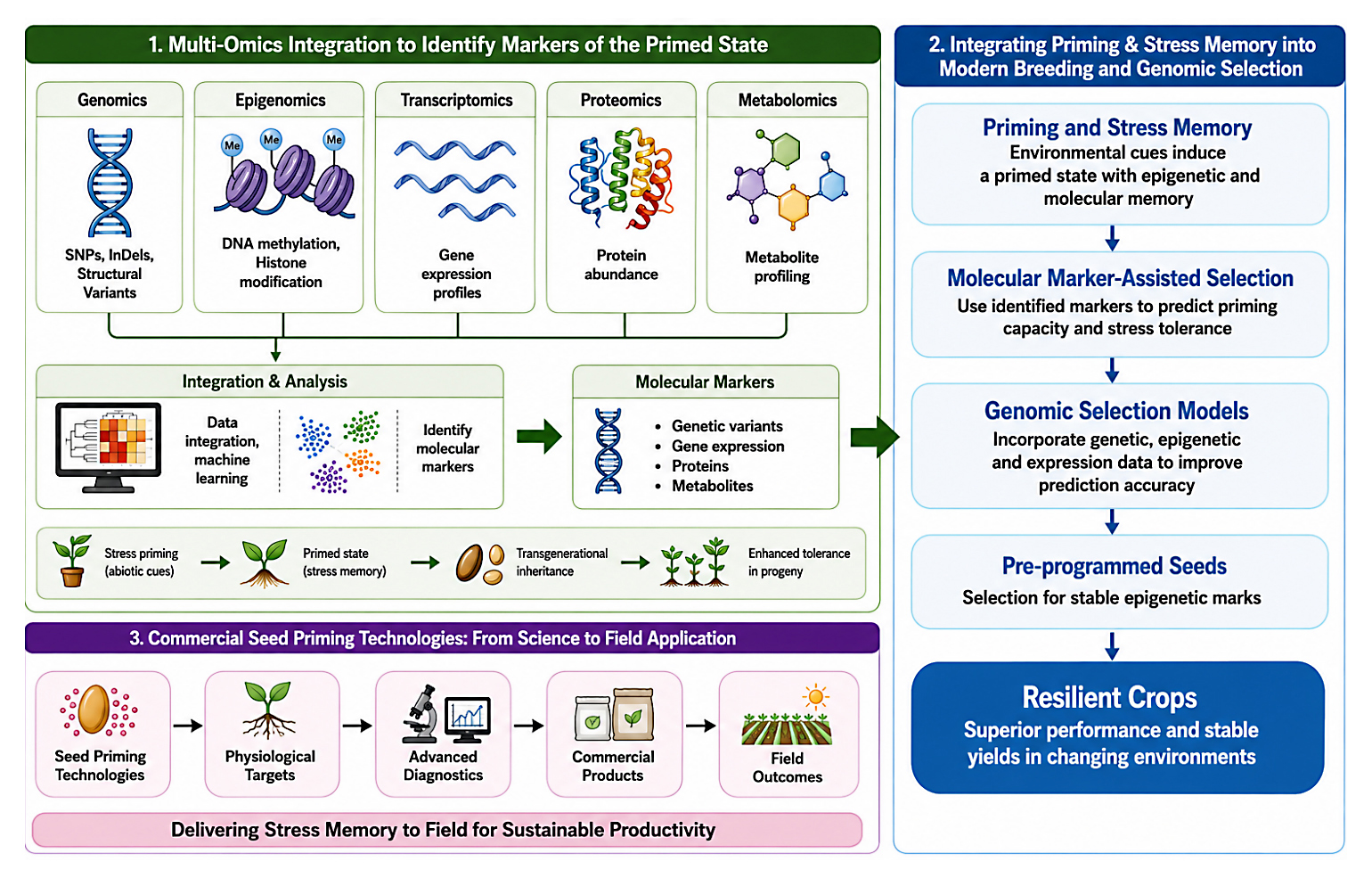 Figure 2.
Multi-Omics Integration and Stress Memory-Based Breeding for Identification of Molecular Markers of the Primed State.
Figure 2.
Multi-Omics Integration and Stress Memory-Based Breeding for Identification of Molecular Markers of the Primed State.
Breeding activities are based on the collection and evaluation of genetic diversity, identification and combination of superior alleles, selection of the best-performing individuals, and the use of advanced biotechnological tools to develop improved cultivars for agriculture [137]. To accelerate precision breeding for stress resilience, breeders can draw upon several complementary molecular indicators: DNA-based markers tagging key candidate genes, transcriptional signatures of early stress-responsive loci, accumulated protective metabolites and stable epigenetic marks that regulate stress memory. Among these, DNA-based markers are particularly powerful for detecting and tracking genetic variation linked to desirable traits [138]. Because they are stable, heritable, and amenable to marker-assisted and genomic selection [139], they enable breeders to move beyond phenotype-based selection, facilitating faster and more accurate identification of individuals carrying beneficial alleles, especially following interventions such as priming treatments [140]. For example, Alwutayd et al. (2026) demonstrated that optimal barley breeding strategies should pyramid favorable SOD alleles on chromosomes 2H, 3H, and 4H, the UV-tolerant chlorophyll allele on 3H, and growth-promoting haplotypes on 6H, while eliminating the germination-suppressing variant on 2H [141]. Such allele stacks are expected to maximize oxidative protection and photosynthetic efficiency without compromising early vigor, thereby realizing the “defend-and-thrive” ideotype required for high-irradiance production systems [142]. Molecular markers are used to screen breeding populations in the field, allowing for the selection of individuals carrying desirable alleles even under variable environmental conditions [143]. Yet, the ultimate test of the value of a genotype is, at the end, its performance in the target environment and its acceptance by farmers [144]. After exposure to stress, the reactions of plants to environmental stress are regulated through changes in transcription, and in this way, the molecular markers of their initial encounter with stress can be preserved through transcriptional regulation [141]. Although most of these changes disappear in the absence of the initial stimuli, some changes may last, resulting in memory formation [145]. This obtained memory provides plasticity to the plant and increases its chance of adaptation. At the same time, it has been shown that transcriptional changes occurring after stress and priming play an important role in stress response and memory [32]. For example, salt priming of Arabidopsis plants with 50 mM NaCl for 24 h led to changes in the levels of H3K27me3 and H3K4me3 histone marks, particularly in genes associated with ion transport, cell wall organization, and hormonal signaling pathways. RNA-seq data revealed upregulation of key genes involved in Na+/K+ balance and cell wall structure [67]. The transition from molecular changes to functional adaptation is realized through coordinated physiological and biochemical changes. Secondary metabolites and macromolecules can serve as useful biochemical indicators of plant responses and desirable traits [146]. However, their application is often constrained by species specificity and strong environmental influences, which can compromise stability and reproducibility. Nonetheless, these markers remain valuable for identifying elite germplasm with enhanced capacity for producing or accumulating specific metabolites or targeting adjustment of their functions [144,147]. For example, seed treatment with melatonin caused an increase in the activity of antioxidant enzymes in triticale and rye seedlings and the accumulation of anthocyanins [148]. Priming soybean seeds with natural biostimulants increased the levels of soluble sugars, free proline, antioxidants, phytohormones, and essential macro- and micro-nutrients, and reduced salt stress toxicity [149]. The longevity of priming benefits hinges on epigenetic stability [32]. Therefore, identifying epigenetic codes of plant stress memory is of great importance in crop improvement [61].
Epigenetic Variation for Plant BreedingConsidering that epigenetics has a fundamental role in the interaction between an organism’s genes and the environment, it can provide novel directions to drive plant-breeding strategies. Epigenetics can help satisfy the demand for new crop varieties, potentially inducing broad-spectrum resistance/tolerance, without genetic erosion, and with a gene-mediated balance between resistance and yield [32,150]. The true power of this modern strategy lies in the integration of stress memory. This memory can persist as somatic memory for days or weeks, but more importantly, it can become transgenerational, allowing the primed stress response to be inherited by offspring for several generations [151]. Somatic or short-term stress priming operates partly through transcriptional poising, whereby stress-responsive genes can remain in a primed state that facilitates their more rapid or enhanced reactivation upon recurrent stress. In contrast, multi-generational and transgenerational priming may involve more persistent epigenomic changes, including alterations in histone modifications such as H3K27me3 or changes in DNA methylation associated with the regulation of stress-responsive genes and transposable elements (TEs) [152].
Integrating this memory into genomic selection represents a vital shift in breeding philosophy; by incorporating epigenetic marks into prediction models, breeders can select for “priming capacity”, the genetic ability of a variety to learn from and remember environmental cues. Epigenetic modifications are highlighted as potential carriers of stress memory and priming effects, which may be inherited across generations. These stable epigenetic marks could serve as molecular indicators for breeding, especially for traits related to stress tolerance and adaptation, though the evidence is still largely circumstantial and their routine use in breeding is not yet established [152]. Epigenetics-mediated breeding (epibreeding) offers a powerful approach to engineer climate-resilient crops by targeting epigenetic mechanisms such as DNA methylation and histone modifications [153]. DNA methylation mediated by the RdDM pathway acts as a mechanism for stress ‘priming,’ enabling plants to retain a transcriptional, metabolic, and physiological memory of prior stresses [154]. This memory enhances survival capacity during prolonged stress exposure [155] as well as recovery following stress relief [156]. Zhang et al. (2025) suggest a valuable strategy for improving maize yield through epibreeding, combining CRISPR/Cas-based epigenome editing technology and Synthetic Epigenetics (SynEpi). Additionally, the creation of Epigenetic Recombinant Inbred Lines (epi-RILs) enables the fixation of specific epigenetic variation, allowing breeders to evaluate and select for beneficial epigenetic traits independently of DNA sequence changes [153]. By selecting for stable epigenetic marks alongside traditional SNPs, breeders can develop “pre-programmed” seeds that carry transgenerational memory, ensuring superior performance in volatile climates without the yield drag often associated with permanent genetic changes [135]. To operationalize this in breeding pipelines, an Epigenetic Relationship Matrix (ERM) can be integrated alongside the traditional Genomic Relationship Matrix (GRM). If priming capacity is associated with stable, heritable epigenetic marks, incorporating the ERM allows prediction models (e.g., Epi-GBLUP) to identify genotypes with a greater propensity to acquire and transmit a primed state [157]. The molecular rationale for this approach is supported by recent multi-omics evidence demonstrating how specific stress memory loci are epigenetically bookmarked. For instance, mild salt priming with 50 mM NaCl in Arabidopsis thaliana preconditions plants for subsequent salinity challenges by orchestrating dynamic changes in the active histone mark H3K4me3 and the repressive histone mark H3K27me3 across key oxylipin and JA biosynthesis genes, including LOX3, AOC1, and OPR3. This locus-specific epigenetic bookmarking pre-activates alpha-linolenic acid metabolism and hormone signal transduction pathways, providing a molecular basis for transcriptional memory and enhanced salt tolerance during subsequent exposure [68].
Integrating epiallelic marks into genomic selection frameworks offers a promising pathway to bridge fundamental chromatin dynamics with applied crop breeding. Supporting this potential, Verkest et al. (2015) demonstrated that in canola, genes involved in the plant response to salt, osmotic, abscisic acid, and drought treatments were specifically differentially expressed in drought-tolerant epilines. The epigenome status, scored as differential trimethylation of lysine-4 of histone H3 (H3K4me3), further supported the phenotype by targeting drought-responsive genes and facilitating their transcription. These results indicate that the canola epigenome can be shaped by selection to enhance both energy use efficiency and stress tolerance [158]. A complementary strategy involves leveraging priming treatments to create crops with enhanced stress memory and resilience through the targeted establishment of beneficial epigenetic states. By stabilizing these epigenetic marks of the primed state through repeated inbreeding, breeders can generate lines in which epigenetic differences are maintained independently of underlying DNA sequence changes. However, the effectiveness of epigenetic stress memory depends on the eliciting stress and the targeted processes, yet the specificity-determining components remain unclear [152].
Conceptually, the interplay between genetic and epigenetic layers underpins both this challenge and its potential solution. Genetically controlled responsiveness constitutes the hardcoded genomic baseline, comprising gene expression cascades, alternative splicing mechanisms, and signaling pathways, that dictates a plant’s innate capacity to perceive stress. In contrast, environmentally induced stress memory is an acquired physiological state driven by prior stress exposure. Mediated by epigenetic mechanisms such as DNA methylation, histone tail modifications, and chromatin remodeling, this memory establishes a primed state that enables faster and more robust defense activation upon re-exposure without changing the underlying DNA sequence. These two layers interact, the genome encodes the regulatory machinery required for epigenetic modification, while environmental cues trigger the deposition of epiallelic marks. Recognizing this interaction allows breeders to target “priming capacity” as a heritable quantitative trait, selecting lines genetically predisposed to retain and transmit stress memory for multi-generational climate resilience [159].
Exploiting Priming for Plant BreedingSo far, priming has been investigated as a mechanism in fundamental rather than applied research, but recent evidence that several pesticides act by priming plants, shows promise for developing future practical applications [31]. However, for plant breeding purposes it is necessary to focus on the use of stimuli that trigger positive, adaptive responses that are capable of establishing stable epigenetic marks to generate a transgenerational memory to stimulate a primed state in plants and enable them to face the changing environment [12]. Therefore, the choice of priming method is based on the specific issue at hand, but the aim is often limited to improved plant yields and yield quality. For example, lettuce as a horticultural crop sensitive to high temperature, does not grow well over a wide range of temperatures, leading to difficulties for farmers during periods of high temperature.
To address this issue, a priming technology called “Thermocure” was developed, which is a mix of hydro-halothermo priming, allowing the lettuce seeds to germinate over a wider temperature range (https://www.seedquest.com/technology/from/Incotec/lettuceprogram/europe2.htm).
The transition of seed priming from a theoretical epigenetic tool to a commercial necessity is currently used by seed companies like ATLAS s.r.l. (Limena, Italy), Germains Seed Technology (Norfolk, UK), and INCOTEC Europe BV (Enkhuizen, the Netherlands). These commercial protocols are designed to bridge the gap between genetic potential and environmental reality by addressing specific physiological barriers. For instance, technologies like EasyDormex, ThermoCure™, and SPLITKOTE® specifically target the removal of thermo- and photo-dormancy in sensitive crops like lettuce and endive, allowing for uniform establishment even in high-heat or low-light conditions. Beyond dormancy, products such as Xbeet® and Emergis® focus on “pre-programming” the seed to improve root architecture and germination speed under multifaceted abiotic stressors in sugar beet, flowers, and herbs. Notably, the integration of advanced diagnostics, such as IMPROVERTM allows one to select primed seeds based on the X-Ray image of the seed interior [160]. Collectively, these commercial treatments serve as the practical mechanism for delivering stress memory to the field, ensuring that crops possess the primed state required for stable yields in volatile climates.
While stress priming provides substantial agronomic benefits by enhancing seedling vigor and stress resilience, several limitations constrain its direct integration into breeding programs aimed at achieving long-term genetic gain. Priming primarily induces physiological, metabolic, and transient epigenetic adjustments rather than permanent sequence-level changes; consequently, its protective effects may diminish during plant development or be reset during meiotic transmission [161]. The incorporation of epigenetic mechanisms into breeding is further complicated by the environmental instability of stress-induced epialleles. In contrast to intrinsically regulated genomic phenomena, such as paramutation, nucleolar dominance, and polyploidization-associated epimutations, which can exhibit stable transgenerational inheritance, environmentally induced epialleles are often metastable, reversible, and sensitive to environmental conditions, potentially limiting their efficacy under variable field conditions [158].
Additional operational constraints include the risk that poorly optimized chemical priming treatments may compromise seed viability, as well as the lack of standardized protocols across species, genotypes, and environments, which limits reproducibility [162]. Thus, priming should be viewed primarily as a complementary stress-management strategy rather than a direct breeding tool. Its contribution to long-term genetic improvement will require the identification and selection of heritable variation in priming responsiveness, potentially through quantitative models integrating phenotypic, genomic, and epigenomic information. In addition, a major challenge remains: reliably identifying which epigenetic marks are truly heritable and stable across generations. Not all stress-induced marks survive meiosis, and only a subset persist into subsequent progeny, limiting the predictability of epigenetic selection. Elucidating the molecular checkpoints that determine whether stress-induced epialleles undergo stable multi-generational transmission or remain transiently responsive will therefore be critical for reliably incorporating epigenetic variation into future crop-breeding and genomic-selection frameworks [151,162].
Priming represents a powerful strategy to enhance crop resilience in the face of climate change and increasing global food demands. By activating physiological, biochemical, and molecular mechanisms, priming enables plants to respond more effectively to subsequent stresses, thereby improving germination, seedling vigor, and long-term performance. Advances in omics technologies and genomic selection are now unraveling the complex regulatory networks underlying priming responses, offering opportunities to identify key genes, pathways, and epigenetic modifications that govern stress memory. However, significant gaps remain in linking seedling responses under controlled conditions to adult plant performance in the field, and in understanding the genetic basis of cultivar-specific priming efficiency. Bridging these gaps will be essential to translate priming into reliable breeding tools. Ultimately, integrating stress priming with modern genomic approaches holds promise for developing climate-resilient crops, ensuring sustainable agricultural productivity, and strengthening global food security.
No data were generated from the study.
The authors declare that they have no conflicts of interest.
The research was funded by the ICGEB DSTI WE-STAR Programme (ZAF/DSI/WESTAR/11).
1.
2.
3.
4.
5.
6.
7.
8.
9.
10.
11.
12.
13.
14.
15.
16.
17.
18.
19.
20.
21.
22.
23.
24.
25.
26.
27.
28.
29.
30.
31.
32.
33.
34.
35.
36.
37.
38.
39.
40.
41.
42.
43.
44.
45.
46.
47.
48.
49.
50.
51.
52.
53.
54.
55.
56.
57.
58.
59.
60.
61.
62.
63.
64.
65.
66.
67.
68.
69.
70.
71.
72.
73.
74.
75.
76.
77.
78.
79.
80.
81.
82.
83.
84.
85.
86.
87.
88.
89.
90.
91.
92.
93.
94.
95.
96.
97.
98.
99.
100.
101.
102.
103.
104.
105.
106.
107.
108.
109.
110.
111.
112.
113.
114.
115.
116.
117.
118.
119.
120.
121.
122.
123.
124.
125.
126.
127.
128.
129.
130.
131.
132.
133.
134.
135.
136.
137.
138.
139.
140.
141.
142.
143.
144.
145.
146.
147.
148.
149.
150.
151.
152.
153.
154.
155.
156.
157.
158.
159.
160.
161.
162.
Hdira S, Donaldson L. Using Stress Priming and Plant Memory to Develop Climate-Resilient Crops: From Physiology to Genomic Selection. Crop Breed Genet Genom. 2026;8(3):e260019. https://doi.org/10.20900/cbgg20260019.

Copyright © Hapres Co., Ltd. Privacy Policy | Terms and Conditions



